Thursday, 4 December 2014

Rainbows, consciousness and yogacara

What is a rainbow? Have you ever wondered that?

Scientifically speaking, rainbows are caused by light being refracted (bent) upon entering a droplet of water, reflected on the back of the droplet, and refracted upon leaving the droplet. This double refraction splits up the light since red light is refracted less than blue light.

So for a rainbow to exist we need sunshine and raindrops... but we need one more very crucial thing – a spectator. Unless someone is present at just the right spot, then there's no such thing as a rainbow. It's just light rays hitting the earth – business as usual! Rainbows are therefore phenomena that require an instrument of sense perception – like a person with an eye, or a camera.


Radical externalism


So what is a rainbow? It's not just sunshine or just raindrops, or indeed the combination of sunshine and raindrops. And it's not sunshine, raindrops and a person – because what if that person was looking the other way...?

In this fantastic article, writer Tim Parks interviews Riccardo Manzotti, an Italian psychology teacher who has a very interesting view on what a rainbow is. Parks describes Manzotti as a "radical externalist" – someone who believes "consciousness is a process shared between various otherwise distinct processes which, for convenience’s sake, we [call] subject and object."

So in his view, a rainbow is what happens when a person perceives light being refracted and reflected like this. Of this event of perception, he says "consciousness is spread between the sunlight, the raindrops, and the visual cortex, creating a unique, transitory new whole – the rainbow experience."

This is what makes him an "externalist" – he sees consciousness as being something that transcends the brain, being shared between the things being perceived (object) and the perceiver (subject). This is in contrast to what might be seen as a more orthodox view, where consciousness is seen as being confined within the brain.

Yogacara


It turns out there's a Buddhist philosophical and psychological system called Yogacara that might help us understand this a little more. Although it's a philosophy, the system comes out of actual practice – people doing yoga meditation over a period of centuries ("cara" means practice).

Everyone knows we have five senses: seeing, hearing, smelling, tasting, and touching, and in order to have these senses we need our sense organs: eyes, ears, nose, tongue, and skin.

Yogacara says that the combination of, for example, our eyes and looking at a rainbow, creates "eye-consciousness" (and the same thing for the other senses). Sound familiar? Yogacara also says we have "mind-consciousness", which is what comes about when the mind perceives something external (so in this example, perceiving the rainbow), or starts thinking and imagining.

So our guy Manzotti, without knowing it, is really a yogacarain. He's re-discovered a philosophy that has been around for about 1500 years! But I'm not sure he would be too happy with this since when asked by Parks if he was aware of Buddhist principles he got irritated, saying he tries "to avoid like the plague being mixed up with anything that smells New Age."! New age... pah!

According to Yogacara, consciousness is what arises when we bring the subject and object of perception together. These are really just two aspects of same reality, and, of course, both subject to constant change. Let's think about this for a moment... the subject (that's you, the perceiver) is subject to constant change. We're not (as my Zen teacher likes to say) solid snooker balls bouncing across the table of life. As Manzotti rightly points out, by thinking consciousness is not just confined to the brain, then we see that we are not separate from the world around us. We are subject to constant change. Our consciousness cannot be separate from the world and cannot survive outside the world.

The Buddha is reputed to have said (something like) "Your life is the creation of your mind."
Yogacara (sometimes called the "mind-only" school) gives us a structure to see how we create our life and how we create our sense of who we are.

Next week I'll continue on this theme and talk about how yogacara sees our ego and our (false) sense of self.


I am a member of the Zenways sangha and teach meditation and mindfulness in Camberwell, London. See my website for further details.

I'd love to hear from you

Are you a radical externalist? Do you agree with our consciousness being something created in partnership with what we perceive? I'd love to hear from you! Leave a comment below, join the discussion.

Pass it on

Enjoyed this post? Then please tweet it, share it on Facebook or send it to friends via e-mail using the buttons below.

Thursday, 27 November 2014

The rational mind should really be just an advisor to the king

After writing my article a couple of weeks ago on intention and gut feeling, I've been thinking some more about how our rational, thinking mind interacts with our emotional, feeling mind. Do you ever catch yourself in a situation where it seems these two sides seem at odds with each other? I do.

Let's say it's raining and I'm trying to decide whether to cycle into town or take the bus. Rationally it would make sense to cycle – it's free, much quicker, and the exercise is good for me. However, I'm a bit tired and I know it's raining and cold, so the bus makes for a very attractive option!

It's very easy to fall into the trap of seeing this as a battle. Do I side with my feelings or my calculations? Which option is best?

My Zen teacher, Daizan Roshi, likes to say the rational mind is like an advisor to the king. If we're not careful, this advisor can easily have delusions of grandeur and assume the role of leader. And I think this position is encouraged somewhat by our society.

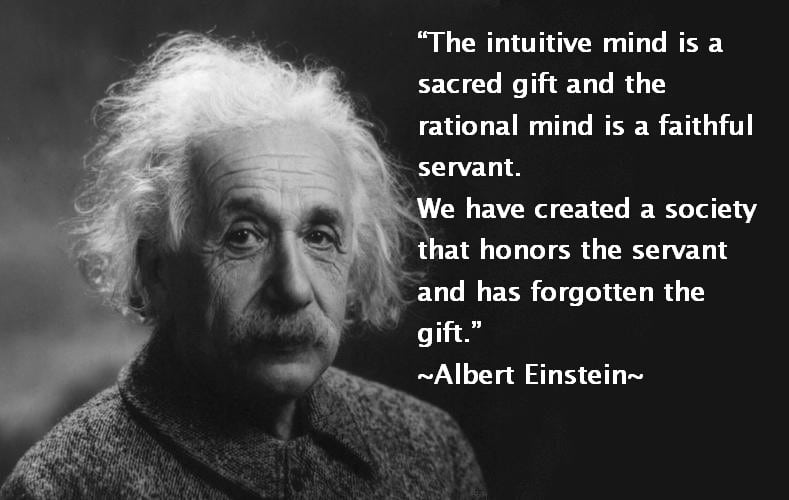
In nursery and primary school our education focusses on our whole bodies – we dance, do drama, and paint with our hands and feet. By secondary school, we're only being educated from the waist up (with occasional classes of PE), and by university we're focussed solely on head-learning. We train the mind to gather and process information – facts, figures, critical thinking, logic, reason – and we test these abilities (and these alone) via incessant exams. The people best at this are ones admired and rewarded most highly in our society: scientists, lawyers, doctors (because western medicine is essentially all reductionist), bankers, computer programmers, etc. On the whole our Western society is skewed towards the rational over the emotional. Einstein knew this when he said
“The intuitive mind is a sacred gift and the rational mind is a faithful servant. We have created a society that honours the servant and has forgotten the gift.”
― Albert Einstein 
The problem is the rational mind is not a good leader. It's too cold and calculating. But it is an excellent advisor. When we let the intuition, the true king/leader, assume its rightful place then logic and reason becomes only one source of information among many. By the same account, emotions and feelings are also just another source of information. In the end I decided to take the bus not cycle!

To take another example, back when I was deciding whether or not to quit my job as an astronomer, my rational mind was screaming "Why quit? You're well-paid, an expert at what you do, and have put in years of training." But it could also calculate how difficult it would be to get a job in the UK and what impact that would have on my relationship. This was all excellent advice. I also knew I wasn't enjoying the day-to-day aspects of my job, feeling quite isolated and frustrated with my colleagues, and I wanted to work more with people in an everyday, grounded sense. All of these things informed my eventual decision, which I feel almost bubbled up out of the muddy quagmire of swirling thoughts and opinions.

I guess you would call that my intuition...


I am part of the Zenways sangha led by Zen master Daizan Skinner, and we meet twice a week at our dojo in Camberwell, London. For more info see www.zenways.org


I'd love to hear from you


Any comments or thoughts about your king and advisors, I'd love to hear from you. Leave a comment below, join the discussion. 

Pass it on

Enjoyed this post? Then please tweet it, share it on Facebook or send it to friends via e-mail using the buttons below.

Thursday, 20 November 2014

The benefits of mindfulness on your health & wellbeing

Many of life’s demands can cause stress, particularly work, relationships and money problems. When we feel fearful or anxious, our body's hard-wired response, evolved over millennia of dangerous encounters in wild, is the "fight or flight" reaction. The problem is that these days, probably the two worst things we could do when faced with, for example, an impending deadline, or an overbearing relative is (1) punch them/someone or (2) run away...

Stress-proofing


Practising meditation and/or yoga, particularly with an emphasis on awareness and mindfulness, has been shown to be an incredibly effective way of stress-proofing ourselves. It does this in two ways: firstly by providing us with a little oasis of quiet in amongst the business of the day (some me-time); and secondly by teaching us how to see things clearly. There's a huge difference between conscious and unconscious stress. The great Zen master Hakuin compared people who were conscious and aware to water whereas ordinary people are like ice. Our mindfulness is like the warm sunlight that can melt away the perceived stress. It's our relationship to the feeling that changes.

Science has been making some great progress in understanding the why exactly lowering our stress levels boosts our health and wellbeing. Let me talk about just a few of the recent discoveries.

Tell me about telomers


Telomers: chromosome caps
Why of course... Telomers are a repeating DNA pattern that act as a kind of protective cap on our chromosomes, shielding their ends from potential damage each time our cells divide and the DNA is copied. In the 1980s an enzyme called telomerase was discovered that can protect and rebuild telomeres. Even so, our telomeres dwindle over time, and when they get too short, our cells start to malfunction and lose their ability to divide – a phenomenon that is now recognised as a key process in ageing. The discovery of telomers won Elizabeth Blackburn the 2009 Nobel Prize in Physiology or Medicine.

As detailed in this lovely article, Blackburn and her group began a study back in 2000 to test the effect of stress on telomer length (at the time genes were seen as being the most important factor, so at the time this idea was highly controversial). The results from their pilot study showed that the more stressed the participants were the shorter their telomeres and the lower their levels of telomerase. Scientists are always marvelled when they manage to connect real lives and experiences to things happening on the molecular level, and in this study they'd done it! Feeling stressed doesn’t just damage our health – it literally ages us!

Researchers have since linked perceived stress to shorter telomeres in Alzheimer’s caregivers, victims of domestic abuse and early life trauma, and people with major depression and post-traumatic stress disorder.

How does it work? The presence of the stress hormone cortisol seems to reduce the activity of telomerase, while oxidative reactions and inflammation (all physiological effects of the stress response) appear to erode telomeres directly. Age-related conditions from osteoarthritis, diabetes and obesity to heart disease, Alzheimer’s and stroke have all been linked to short telomeres.

In one follow-up project, Blackburn and her colleagues sent participants on a three-month meditation retreat, and found that afterwards they had higher levels of telomerase than the control group. A study in 2013 of dementia caregivers found that, after practising 12 minutes of meditation a day for eight weeks, they had significantly higher telomerase activity than a control group. And in another study in 2012 Epel et al. measured the association between telomere length and peoples' natural level of mindfulness. They found those who reported high mind wandering (i.e. lower mindfulness) had shorter telomeres, even after adjusting for stress.

So stress and ageing are clearly very related. No wonder Wallace et al. back in 1982 found that people who'd been practising meditation for five years were physiologically (as shown by their blood pressure, vision, hearing, and skin elasticity) up to 12 years younger than their non-meditating counterparts! For more on that, see this article showing some photographic evidence, or just look at any photo of a prime minister or president – in just a few years they go from looking fresh and vibrant to grey, haggard, and worn out!

New genes, new neurons


In another study, a group based in Massachusetts took blood samples from a group of 19 people who had regular meditation practice, and 19 others who never meditated, and ran genomic analyses (identification of genomic features such as DNA sequence, gene expression, etc) of the blood. They found that the meditating group had suppressed more than twice the number of stress-related genes than the non-meditating group. This is an incredible result, since the more these stress-related genes are expressed, the more the body will have a stress response. This study is in the field of epigenetics, which I've written about before.

Lastly, I just wanted to mention this article detailing some work done here in London that found that increased levels of cortisol seems to decrease neurogenesis (the ability of the brain to produce new brain cells) in adults. Studies have shown that these adult-born neurons appear to have a role in the regulation of stress by possibly augmenting the role of the hippocampus in controlling the stress reaction and/or inhibiting the amygdala (the region of brain responsible for the fear reaction). Neurogenesis has also been linked to brain plasticity.

So, it's never too late to start practising mindfulness and meditation, and slowing down – possibly even reversing – the ageing process!

My next 8-week course in Mindfulness for Health & Wellbeing will start on Friday 16th January, and I'm now taking bookings. See my website for further details.


I'd love to hear from you


If you've noticed that, like me, your mindfulness practice is leaving you looking younger and more radiant, your skin is shiny and there's more of a healthy glow about you, I'd love to hear from you! Leave a comment below, join the discussion. 

Pass it on

Enjoyed this post? Then please tweet it, share it on Facebook or send it to friends via e-mail using the buttons below.

Thursday, 13 November 2014

Intuition and gut feeling

In Zen practice we purposefully cultivate attention in our hara, our belly, our gut. We emphasise turning off our discriminating, thought dominated mind, and develop a kind of knowing that is beyond this’s and that’s, right or wrongs – essentially beyond language itself.

One word in English that we often use to point to this direct knowing is “intuition”. Intuition is defined as an "almost immediate situation understanding” – a kind of direct, immediate knowing. “How do you know that?” someone asks, and you reply “I don’t know, I just do”. This is intuition speaking. Like a hunch or a feeling. You arrive at a conclusion through processes that typically remain mostly unknown to your conscious mind.

The word intuition comes from the Latin intuir, which means ‘knowledge from within.’ In the last few centuries intuition has been kinda poo-pooed because it’s not rational - it's “just a feeling”. With the rise of science in the West, rational thought has rather taken superiority.

Second brain


Recently there’s been quite a bit of discussion about what people call our "2nd brain” down in our gut. This 2nd brain consists of sheaths of neurons embedded in the walls of our gut – intestines, stomach, etc. – about 100 million of them in total. That's more than in either the spinal cord or the peripheral nervous system (but a good deal fewer than in our 1st brain!). The feelings from these gut-nerves influence, to quite a large degree, our emotions, so you could say our second brain very much informs our state of mind. One obvious example is when we feel butterflies in the stomach. The butterflies sensation arises as blood is redirected out of our digestive system as part of our flight or flight response, and it signals to us we’re feeling nervous or anxious. As it says here, a lot of the information that the gut sends to the (head) brain is about well-being, which is understandable since eating and digestion are fraught with danger! Like the skin, the gut must stop potentially dangerous invaders, such as bacteria and viruses, from getting inside the body.

Intuition is a very undervalued and underused skill in most people. But interestingly, people with certain types of brain-damage who can’t form emotional intuitions can take hours to decide between two kinds of cereal! They’re caught trying to reason out whether they want Frosties or Coco Pops, and ultimately it’s not a rational decision (any rational person would choose muesli...).

In research, you’ll often start solving a problem by going with a hunch – it’s what sends you off in one particular avenue of enquiry over all the others you could go with. Einstein knew:
The workings of intuition transcend those of the intellect, and as is well known, innovation is often a triumph of intuition over logic. – Albert Einstein

How does intuition arise?


Obviously intuition doesn’t just arise out of nothing. The more experience you have, the better your intuition. Intuition arises out of a rich array of, what you might call, patterns of experience – memories, understanding, learning, observations, that all become integrated into your being. 
As Massimo Pigliucci explores in his book, "these days cognitive scientists think of intuition as a set of nonconscious cognitive and affective processes; the outcome of these processes is often difficult to articulate and is not based on deliberate thinking". In his famous book "Thinking, Fast and Slow", Nobel Prize winning author Daniel Kahneman notes that "thoughts come to mind in one of two ways: either by “orderly computation,” which involves a series of stages of remembering rules and then applying them, or by perception, an evolutionary function that allows us to predict outcomes based on what we’re perceiving. It is the latter mode that precipitates intuition."

So let's say you're a company executive conducting interviews for a job. You've been at it all morning and none of the candidates have been any good. On paper, the next two candidates have everything and you're excited. The first one interviews very well, comes across confident, gives well thought-out answers, and has great body language. The second one also answers well, is inquisitive, quick, and well-presented.

So who do you choose? From a rational point-of-view, both are equally good, but you just get a feeling that the first one hasn't got what it takes. The feeling arises from your gut (what in Japanese they call the 'hara'), and informs the decision made by your brain.

Intuition in Zen


In Zen, however, we're moving to a place of intuition that's not based on memory, experience, or discrimination. By going beyond just knowing about things to actually perceiving things directly, we come to understand our true nature and in doing so literally become the whole Universe. And if we are the whole Universe, then there's no finding out – we know. We enter the flow of the Universe so fully that the 'knowing' is no longer ours, but an obvious, immediate response of the Universe.

As a teacher, this is a very valuable tool. The more sensitive you are, the more you can enter this flow, and the less our feelings are coloured by our own desires, wishes or judgements, then the more truthfully we can 'intuit' how another is feeling.
Years of training, repetition, beds experience into being,
And from the gut arises direct knowing, a felt sense.
So easily coloured by desires,
Train hard and make discernment clear.

I am part of the Zenways sangha led by Zen master Daizan Skinner, and we meet twice a week at our dojo in Camberwell, London. For more info see www.zenways.org


I'd love to hear from you


If you've read any of the booked I mentioned, or have any other comments about intuition, I'd love to hear from you. Leave a comment below, join the discussion. 

Pass it on

Enjoyed this post? Then please tweet it, share it on Facebook or send it to friends via e-mail using the buttons below.

Thursday, 6 November 2014

Feeling sad, being depressed and how mindfulness helps

We all feel sad, lonely, or depressed at times. Feeling depressed now and then is normal, perhaps we feel a little lonely, we're grieving a loss, maybe lacking in sleep and exercise, or work is being particularly difficult. Depression is a continuum of feeling. For some of us, though, we end up edging towards the dark end, and that's when these feelings can become overwhelming, begin to involve physical symptoms, and last for longer periods of time.

Depression is when we feel sad and low for weeks or months on end. It's not just a passing blue mood. The exact symptoms of depression can be complex and vary widely between people, but it's often accompanied by feelings of hopelessness, a lack of energy, and taking little or no pleasure in things that you once enjoyed. Sadly, anxiety and depression are the most common mental issues in Britain, and between 8-12% of the population experience depression in any year.

Many people come to believe there is something fundamentally wrong with them, but that isn't the case at all. Often it can be to do with lifestyle and external factors, like isolation, grief, or stress.

Happily, mindfulness, either practised in stillness or through yoga, has been shown to be incredibly effective in helping people deal with depression. In this interview with leading mindfulness and depression expert John Teasdale, he explains that depression is often fuelled by streams of negative thoughts going through the mind. This replaying of negative or unhelpful thoughts is termed "ruminating".

Even if you don't suffer from depression, we can all connect with what it means to ruminate, to dwell on negative events, or (more technically) to compulsively focus your attention on the symptoms of your distress. I found myself doing this the other day when I broke a dish in the kitchen...

Replaying of negative or unhelpful thoughts is termed "ruminating". In mindfulness, we gently redirect our attention away from these ruminations to what's happening in the present right now, thereby breaking the cycle.

In mindfulness, we practice bringing our awareness to what's happening or we’re doing right now, gently redirecting our attention away from these ruminations as and when they arise. As John Teasdale describes, by doing this we 'starve' the thought streams of the attention they need to keep going.

By bringing our attention back to the here and now each time we wander off into a thought stream, we learn to live more in the reality of the present moment and less in our heads, going over and over things that happened in the past, or worrying about the future.

But it's important as we practice, as we notice the "magnetic pull” of the negative thoughts and feelings that we apply an attitude of kindness, acceptance, and non-judgement. It only adds suffering to suffering to add criticism and judgements to what we find. It may be that, up to now, these negative thoughts formed a big part of who we perceive ourselves to be, so it's even more important to be gentle, patient, and forgiving of ourselves.


My next 8-week course in Mindfulness for Health & Wellbeing will start on Friday 16th January, and I'm now taking bookings. See my website for further details.


I'd love to hear from you


If you've found mindfulness or yoga to help with negative feelings or moods, I'd love to hear your experience. Leave a comment below, join the discussion. 

Pass it on

Enjoyed this post? Then please tweet it, share it on Facebook or send it to friends via e-mail using the buttons below.


For more on the clinical research into the effectiveness of mindfulness on depression see here http://mbct.com/clinical-research/

Thursday, 30 October 2014

Releasing tension and stiffness helps us feel more

Tension and stiffness in the body create numbness. They create a barrier to awareness and the full experience of life. If we can’t relax, then life becomes dulled; the extra tension is tiring to hold and inevitably produces an undercurrent of fatigue. Look around you when you walk through the streets of the city and you'll see tension is a chronic condition. Happily through, yoga and meditation practice teaches us how to begin releasing all these tensions, better align and balance ourselves, and brings us to a new appreciation of the incredible vibrancy of life.


Perhaps one of the first things we notice when we start with our yoga and/or mindfulness work are these areas of stiffness or tension – and for some of us discomfort or even pain. They come about for a number of reasons, and can affect us on various levels: from the superficial to the deep. Causes include:
  • our genetics (for example weak joints mean the muscles have to work harder, or scoliosis causes asymmetries in the spine muscles)
  • past accidents (e.g. a broken toe meant you avoided putting weight on that foot and now the other leg feels overworked)
  • past traumatic experiences (the body mirrors the mind in wanting to protect our soft vulnerable parts so often we end up hunching over)
  • our occupation (e.g. sitting at a desk for long hours with bad posture)
  • our hobbies (e.g. playing or doing an asymmetric sport like tennis or shooting)

So you can see that the reasons our body might be tight or stiff are intimately connected to our past, our upbringing, and our life choices.

I can see now that when I started my own journey into the world of yoga and self-exploration, I was pretty numb, desensitised, and tense! There were many blockages and tight areas, and I was nowhere near being able to feel the subtleties I'm now able to tune into. In the words of a good friend of mind, I was a brut... An insensitive, lumbering vertebrate with his heads in the clouds and a body that, if on a map, would be labelled “here be dragons”!

When we experience unpleasant sensations in our life, one of our strategies for blocking these out (after all no-one wants to feel unpleasantness!) is to tense up, because tension causes numbness. The body learnt that a long time ago!

Releasing the tension


For many years I understood in my head that yoga could help us release the tensions, blockages and imbalances, but I struggled to relate it to any actuality in my body. I could see my weight changing, muscles developing, and stamina improving, but had no sense of my body coming into better alignment or flow.

It took a sustained level of awareness and the keen eyes of my Zen teacher Daizan Roshi and yoga teacher Jonathan Monks to show me, on a physical body level, that this was actually happening. Through my yoga and meditation practice (and to some degree through my years of psychotherapy), I'd begun to let go of my body’s patterns of tension. Slowly, I’d begun to dismantle the layers of holding and blockages built up over years and years. With alignment, mindfulness and relaxation I suddenly found I could feel finer and subtler sensations in the body that I’d never noticed before.

One of the keys to releasing tension and encouraging relaxation is bringing the body into correct alignment. By aligning ourselves with the vertical, with our innate sense of “up” and “down”, then the force of gravity will support us instead of weigh us down. Right now try leaning to one side. It takes work! So aligning of the physical body with gravity allows us to relax and shed unnecessary tension. This is why in meditation sitting up straight is so important, and why in yoga we learn to move with gravity, not against it.

In the words of Will Johnson (from his lovely book Alignment, Relaxation, Resilience), I've started tuning in to the "fine, shimmering currents of sensation that constantly flow through the body”. As I described in this previous post, these are the shimmering currents of our subtle bioelectromagnetic field.

Spiritual energy by Alex Grey

Thursday, 23 October 2014

Meditation is not about clearing your mind!

One of the most common misconceptions about meditation is that it’s all about clearing your mind. And sadly this idea seems pretty pervasive. Most people I talk to who've never done much meditation before say something like "oh I can't do meditation, I can't clear my mind".

I'm not surprised! Clearing the mind is nigh-on impossible! Even for someone like a Zen master with decades of meditation experience. But perversely it's often this clear, calm, unaffected mind-state that brings people to meditation in the first place. We all want to find some respite from the whirlwind of thoughts and worries in our heads.

Then when you try it and find your mind is anything but clear, it can be very frustrating!

I think one very useful way of thinking about the brain is like any other organ. The function of the heart is to pump blood; the function of the stomach and intestines is to secrete enzymes and digest food; the thyroid to secrete hormones; and likewise, the function of the brain is to secrete thoughts. Thoughts are a natural product of the brain. Why would we want to stop them?

It's not the thoughts themselves that are the problem, it's how we engage with them. So often we unconsciously end up following trains of thought, and, more often than not, these end up going down a negative route, leading us into worries and anxieties.

Mindfulness is all about developing our awareness of how things are in this moment, without trying to change it, or judging it to be good or bad. So when we come to practising our mindfulness meditation, our first job is to notice just how busy the mind is. Some days it might be as busy as the M25 at rush-hour, and other days like a quiet country road... Either way, that's fine. One of the most wonderful effects of observing the mind as it is right now without trying to manipulate it in any way is that it automatically begins to calm down. The less we try, the more it responds.

One helpful analogy to how our mind and thoughts work is the following. Imagine yourself walking deep in the countryside and you come to a river. You take a rest and come to sit on the river bank. In this analogy your thoughts are like the water in the river, flowing naturally downstream. Let's say you find a few large logs and attempt to dam up the river – you try to "clear your mind". Firstly, this takes a great deal of effort. You might succeed in creating a dam, but sitting back to admire your work you see that the water level is gradually rising behind the dam. At some point it either flows over or around the dam, or the dam breaks...  It's much easier just to let the water flow.


The other trap we get into is jumping into the river and grabbing hold of the various thought forms that flow down this river. Let’s say you see something awful on the news. Immediately your mind is flooded by a whole range of negative thoughts and emotions like anger, sadness, fear, revenge. Before you know it, your mind is grabbing similar thoughts from its memory banks, and new thoughts come in followed by more emotions. The next thing you know, you're totally consumed by these thoughts, wondering about the safety of those you saw on the news, of you, your family, friends, what to do about it, how to stay safe, etc.

So instead of engaging with these thoughts as they arise, in our mindfulness meditation we practise simply observing the thoughts – sitting by the riverside, seeing the flow of thoughts for what they are. Not trying to block them, but also not grabbing hold of them. We practise making the choice not to engage with the thoughts as they arise, so we have that choice in every part of our life. Sometimes it's imperative that we do engage with our thoughts, but sometimes it's more healthy not to.


I teach 8-week courses in Mindfulness for Health & Wellbeing regularly through the year in Camberwell, London. See my website for further details.

I'd love to hear from you


If you've found mindfulness or yoga to help with negative feelings or moods, I'd love to hear your experience. Leave a comment below, join the discussion. 

Pass it on

Enjoyed this post? Then please tweet it, share it on Facebook or send it to friends via e-mail using the buttons below.