Showing posts with label flow. Show all posts

Thursday, 10 October 2013

What's in a front door? [a poem]

Delivering flyers. Delivering potential. Delivering junk to be recycled!
Lots of front doors, front gardens, front steps.
21A is up and 21B is down.
Letter boxes: flappy, tight, snappy, shite... vertical?
Behind their shiny exteriors, stiff draft excluders - not just drafts they keep out.
Lift the old chipped ones though and the opening is clear,

the leaflet glides with a cheer.

What's behind the door?
A pile of other unwanted junk mail?
An interested householder?
A single mum with no time to sleep, let alone yoga?
A hungry dog?

A keen yoga bean?
Only builders?

Frustrating letter boxes.
Getting hot from all the stair climbing;
Come on you, stop whining!
This is part of my job now;
I'm a yoga teacher, web designer, leaflet dropper.
Leaning down to open the flap, like a bow.
Finding grace. Finding flow. The true nature of the universe.

250 down, more hundreds to go.
They say one hour of advertising for every hour of class.
Potential... who knows.
But I will see you again, street of many houses.

Street of potential. Connections, meetings.
Street full of real life. Suffering, laughing, living.

Yoga offers ways to heal.
Are you ready? Come join me.


Wednesday, 2 October 2013

Bridging the space between formal practice and everyday life

What situations do you find hardest to stay mindful, to keep the ego from rearing up, to remain true to yourself, to stay in the flow?

I'd guess it would be a situation involving a group of people. Maybe your family, maybe work colleagues, housemates... The closer they are, the better they know how to press your buttons!

So maybe we can do yoga or sit in meditation and observe our tendencies to judge ourselves, perhaps as someone who's easily distracted, or someone who always wants to make things ok, or worries about what others think of us doing yoga or meditation. Maybe we can even start letting go these "I am" identifications: "I am a person with tight hips", "I always get angry when I can't do something", etc. But how does this help at a family dinner when your adversarial uncle starts drawing you into a conversation on the rights and wrongs of intervening in Syria? It's not much use to pull out your best warrior II pose on him... (might make him shut up for 5 mins though!)

It's not easy to bring what you learn on the mat or on the cushion into everyday life. But isn't that why we call it a practice? We're practising for everyday life. And what use is a practice where you can achieve beautiful flowing, non-dual, ego-less, oneness for 30 mins a day but still bite your colleagues head off in your morning meeting?

That's why it's helpful to build a bridge into our practice. A bridge between formal on-the-mat/cushion time and normal life. We create time to do a reasonably unchallenging activity 100% mindfully, bringing our practice to bear on something that isn't on the mat/cushion.

For this reason, in Zen we practice working meditation, or Samu in Japanese. It's emphasised to such a degree that it's actually one of the four principal components of Zen practice (along with sitting meditation, private meetings with your teacher, and talks).

Working meditation includes the practice of mindfulness, giving or generosity, duty, and selfless service. In Zen monasteries every monk (or retreat participant) has a duty to do work for the maintenance and upkeep of the building and grounds, or help with the cooking, shopping, accounts, etc. But it's more than a duty - the task is performed with the same mind as sitting meditation. Doing the activity 100%, becoming the activity. An opportunity to put what you've learned on the mat/cushion into practice.


Me doing samu on retreat in Japan (weeding the gravel)
For inexperienced practitioners (like myself), the working meditation activity should be super-simple: something like cleaning, gardening, or chopping wood/vegetables. The repetitive simplicity of these kind of activities needs very little thinking power, leaving plenty of energy to devote to being 100% mindful. A favourite
in Japan is weeding the gravel in the monastery garden (see photo).

Can you see the true nature of the universe in every weed you pick? In every stone or piece of earth you move? Can you disappear into the flow of the cleaning cloth sliding over the kitchen floor?

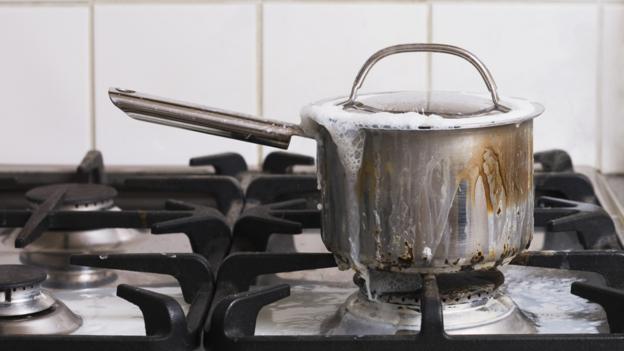
Gradually as our practice develops and we're able to stay with it more and more doing simple tasks, we can introduce some harder things. Cooking, for example, requires much more cognitive input, but can you stay 100% mindful when the saucepan is boiling over but the recipe says "gently simmer"?

I remember my teacher Daizan saying that the monastery accountant is always one of the most senior monks because it takes a very developed practice to stay 100% with it when you're doing the books!

So you can see that letting go of our frustrations, our right/wrong judgements, our need to win the argument, remaining empathetic, compassionate, loving, and not letting the ego direct our actions is hard enough when we're just hoovering the living room. Doing all that whilst your uncle is banging on about how important it is for our economy to maintain a military presence around the world, including Syria, is advanced practice!

Start small, and build up. If we're patient, diligent, and compassionate, one day we might find ourselves flowing through every situation with ease, being 100% our true nature without a speck of self.

Thursday, 26 September 2013

Being in the flow

Back in the 70s a Hungarian-born psychologist called Mihaly Csíkszentmihályi (points for correct pronunciation) coined the term "flow". To be in the flow. To be in the flow state.

But what does it mean to be in the flow? I'm absolutely sure you've experienced it at one time or another. It's when time just seems to fly. All concept of time disappears, we're completely absorbed in whatever we're doing. According to Csíkszentmihályi it's "the creative moment when a person is completely involved in an activity for its own sake". Being in the flow seems to lead very naturally to happiness.

People often go to extreme lengths to get into that feeling of flow. When you're skiing down a tricky piste, bungee jumping, racing at high speed, or paragliding, you can't not be in the flow - or you might die. It's addictive because it feels great. And it's not just the adrenaline; you begin feeling at one with the universe. It may be the closest some people get to a spiritual experience.

But the question is do we need to go to those extremes to get there?

Csíkszentmihályi came up with a plot showing the ways we can come into this flow state (see his talk on TED), based on the challenge of the activity and your skill in doing it.


According to him, you need sufficient skill, and the activity needs to be sufficiently challenging. Not enough skill and you become anxious or worried, not enough challenge and you get bored or even apathetic.

Let's take the example of doing a sun salutation in yoga. When you're a beginner it's very challenging and we're unskilled (that's certainly how I remember it!). Our bodies are stiff, we don't know the sequence, we tire very quickly, and we get feelings of worry, anxiety. "I'm rubbish at this, my body isn't good enough." Gradually you get better at it, your muscles and joints loosen up and you get the sequence memorised. You move through the arousal stage (cor, my body is loving this), you start to feel in control, until one day you find ourself moving without consciously thinking - you're in the flow. You're so involved in the activity that there is nothing else.

The same thing goes with, for example, learning to ride a bike or drive a car. 


So by focussing on an external object in this way we become more and more alive. Our life becomes present and vivid.
... And I would argue that the activity has to be neither challenging nor require much skill for you to get into the flow. All you need is to be mindful. Simple, repetitive tasks can actually work very well - like weeding, cleaning or washing up.

But as Zen Master Koun Yamada says, "when we concentrate on an object outside ourselves, for example archery where we aim at a target, no matter how strong the concentration may be, we cannot attain the Zen experience." So in meditation when we're aiming towards waking up to reality (enlightenment), we need to be absorbed inwardly.

The other thing about the flow state is that it's ephemeral. Like sleep - the more you try the harder it gets. You've got to let go into the flow. And you can't hold on to it either. As they say in Zen, you can trail your hand in a mountain stream and enjoy the cool, fresh water, but as soon as you try to grab hold of any you come up with nothing.

One of the reasons people get addicted to flow-inducing extreme activities is that when you're completely absorbed, there is no ego. That sense of self (little old me, and the big Universe) disappears, and that's why you get those feelings of oneness. When the concept of self dissolves, you are the Universe. You touch your true nature.

But it's no use to you (or to others) if you can only feel at one with everything when you're surfing a 4m wave - unless your friend who needs advice and a shoulder to cry on can come with you on the surf board! That's why we start learning to find that flow state during more mundane activities, then gradually during more inwardly focussed practices (as Master Yamada said).

But it's one thing being in the flow riding your bike, or ironing shirts, doing a sun salutation, or observing your thoughts and sensations on the meditation cushion. Can you live permanently in the flow state? I believe you can - I'm nowhere near there though. It takes lots of practice. Letting go, letting go, letting go, not holding on.

Mindfulness practice is one of the first steps into this. Bringing your thoughts sensations actions into your awareness, letting them be, accepting, acknowledging, and not judging. We cover this extensively on my 8-week mindfulness courses. For more on flow and it's connection to mindfulness, see this great article.

Thursday, 22 August 2013

David Mitchell's living in the moment

Someone sent me a link a while back to an episode of David Mitchell's Soapbox (on the Guardian) called 'Living in the moment' (watch it here). True to his reputation it's wonderfully provocative! I thought, given my upcoming courses in mindfulness, it might be good to have a little look at what he's saying.

He starts off boldly: "It's no longer good enough to live in a way that you're happy with and doesn't enrage others. No. We're now supposed to live in the moment. It's not enough to work towards being happy later, you have to be happy now. Right now! Not soon, but now." Then he steps back a little and adds "OK, maybe not all the living-in-the-momenteers are saying that's the only way of being happy"... "They're recommending this as a way to become happy. Are they mad?"

As I said, provocative! I guess I can count myself as a living-in-the-momenteer. Am I saying that? Well, yes.

He goes on to describe why he thinks we're mad. And this is where he gets a bit confused about what it means to 'live in the moment'. "The ranges of pleasures", he says, "to someone living in the moment is both small and bestial. Unless you're in the middle of something delicious, intoxicating, carnal, or having a sneeze, you're stuck. And the only one that doesn't involve any forethought at all is sneezing...".

Here, I think is the crux of the matter. Can you plan for the future whilst living in the moment? As I see it, it's all to do with how you approach things. You can make plans whist fully being in the present moment.

Let's take dinner tonight as an example.

Approach 1: I anticipate I will feel hungry. I predict I'm going to want to eat lasagne but I know I don't have all the things in my kitchen that I'll need to cook it. I make a list of what I need and plan which shop(s) I'll go to. I get home and start cooking, all the time worrying whether it'll turn out ok, whether I've got the bechamel sauce the right consistency, etc. I finally sit down to eat the lasagne, fantasising about how tasty it's going to be. I start eating, enjoy it for about 5 seconds, then start replaying in my head a conversation I had with someone earlier, planning how I'm going to advertise my yoga classes better, etc. I think about how I might improve the lasagne next time, how much washing up my cooking has generated, or what I might have for dessert. Afterwards I might think back and remember how nice the lasagne was.

Approach 2: I recognise the beginnings of hunger sensations in my belly. The thought of lasagne naturally pops into my mind. I check the kitchen to see if I have everything I need, and appreciate the lovely spice smell that comes out of the cupboard above the toaster. I make a shopping list noticing how the ball of the biro I'm using is all gunked up and smudging on the paper. I leave the house and walk to the shops; the sun warms my face and I feel the weight of my feet as they step step on the pavement, the awkwardness of the shopping bags as they bang against my legs. I get home and start cooking with my mind focussed on the present moment sensations in the act of cooking. I'm in the flow - so engrossed in the task that there is nothing else. The rest of the world disappears. I sit down to eat the lasagne, absorbed in the beautiful flavours, textures and smell of the food. There are no thoughts, simply the awareness of the present - whatever is going on.

Which approach do we take most days?


This quality of flow deserves a moment to think about. It's a fairly elusive state. As with sleep, you can't just will yourself into it - all you can do is create the right conditions and let it happen. Like trailing your hand in the cool water of a stream, it's very pleasant but as soon as you try to grasp it you come up with nothing. It also embodies an apparent paradox: how can I be living in the moment if I'm not even aware of the moment? David Mitchell highlights this as a weakness of mindfulness practice. However, spiritual practice is full of apparent paradoxes. When you're in that flow, does the paradox still exist?

"But what about anticipated pleasure?" David Mitchell asks. He gives the example of watching the 2001 film Mulholland Drive, "believing he was enjoying watching the film and anticipating an ending that would resolve and make sense of the mystery". However, because there was no such ending he said he was forced to "retrospectively downgrade what he thought had been his enjoyment in the moment." This made me chuckle!

Another example he gave was sport. The games you enjoy most at the time, he suggested, are the "ones where the teams or people you're rooting for go into the lead early and stay there until they win." But in hindsight, the ones you enjoy most are "where it's touch and go for the whole game then they win." He explains that his dominant emotion at the time of watching is "I really hope they win so it will turn out later that I'm enjoying myself now".

But all this hinges on the attachment to an outcome, and this is the fatal mistake we all make time and time again. Is enjoyment only to be derived from a win? If you're trapped in thoughts of the future we forget to experience (let alone enjoy) what's happening right now. Aren't there enjoyable moments in a game regardless of who's winning? And why on earth would you "retrospectively downgrade" your enjoyment of a film just because it didn't end in a way you wanted it to?! That is mad! Ironically, letting go of what you want is the only way to find the benefits of mindfulness.

David Mitchell ends by concluding that "all enjoyment is a variation on a theme, which is chores now for jam tomorrow." Nice one-liner! But I'd say the essence of mindfulness is really to be present with your chores. Enjoy them, savour the smell of freshly laundered clothes, the gliding motion of the iron, let yourself disappear into the rhythmic backwards and forwards of the cleaning cloth in the bath. Don't worry about the jam - it might or might not come. But doesn't the wonder of how the water flows over the colourfully dirty dishes outweigh any potential future possibility of jam?

For some great further reading, have a look at this lovely article in Psychology Today The Art of Now: Six Steps to Living in the Moment

Or this article in the Guardian Living in the moment really does make people happier

(or sign up to one of my courses on mindfulness! www.youruniverseyoga.co.uk/mindfulness)

David Mitchell's Soapbox logo