Showing posts with label hara. Show all posts

Thursday, 10 September 2015

Zen pilgrimage walk: Wisdom of the robes

I recently got back from a 4-week pilgrimage walk through the country, which I did as a Zen monk – carrying no money, just living from my alms bowl. In the first article in this series I talked about why I would even do such a thing, then I discussed the pain in my feet and how I dealt with it. Last week I talked about living from the bowl and the wonderful generosity I found along the way.

This week I want to focus on what I was wearing and the wisdom I found within it. Will you stay with me? (couldn't resist the alliteration!)

No, I don't mean Daizan had tucked a booklet of Zen wisdom into the folds of the robe for me to find (sadly!) – I mean the wisdom embedded in the design and material of the outfit.

The robes


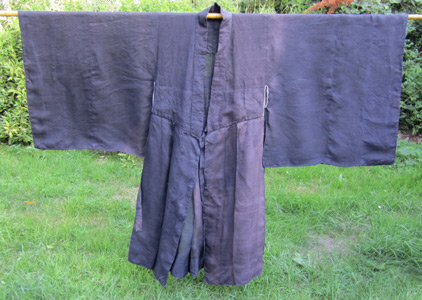
If you had to wear one set of garments for travelling on the road, and you weren't going to add or take away any layers, then the monk's robes I had weren't far off the ideal. There are three layers: the undergarment is called a jubon and is equivalent to a shirt. It's waist-length and folds over the body in the traditional Japanese way. The second layer is called a kimono and mine was grey (can also be white). This, again, folds over in the same way, but is full-length down to my ankles. These two inner layers, folded around the body, are held together with a wide, elasticated belt called an obi. The third layer is the outer koromo, made of a kind of denim material (indigo hemp I think) that comes down to about mid-calf level, has large sleeves, and has ties at either side at the waist to fasten it.

Traditional Rinzai Zen monk's travelling clothing

Another belt called a shukin is wound around the waist to hold everything together (more on that below). The lower part of the robes could be hitched up underneath the shukin (on warm days or to make walking easier), and the long sleeves could also be tied up at the shoulders (again for warm days).

Robes with the sleeves tied up, showing the shukin belt with the rakusu tucked behind it.


Shukin


The skukin (meaning "hand cloth" in Japanese) is a very interesting part of the robes (the Soto school has a similar rope belt called a shiken). I haven't been able to find out much about its origin, or why it's tied in such a way (some info here if you want to dig). At first it seemed an unnecessary weight and a bit of a hassle, but as time went on I began to see the deep wisdom embedded in it.

After a few days of walking I noticed that I wasn't feeling that hungry during the day. It was only when I stopped for the night and undid my robes that I started feeling hunger pangs.

Influenced by the monastic culture at the time, the Buddha only ate breakfast and lunch, and in fact made a rule that his monks shouldn't eat after midday. Monks in the Buddha's day also didn't work or cultivate the land, relying only on alms food. As Buddhism spread north into China, the Chinese weren't so happy with supplying the monks with 100% of their food, so they began farming the land around the monasteries. The colder climate and the extra work meant monks had to eat more (and wear more). To begin with, they kept with the 'no eating after midday' rule, and in the evenings the monastery kitchens gave out hot rocks that the monks would put on their stomachs to assuage their hunger. As Zen spread into Japan, they relaxed the after-midday rule, and the (still unofficial) evening meal became known as yaku seki (meaning "medicine stone").

So the pressure and warmth of the shukin belt against my belly as I was walking must have been doing the same job of stopping any hunger pangs.

The other effect I noticed was that it really helped bring my attention to my hara. In a way it felt like a weight-lifters belt, but swivelled around 180deg. It held everything in, and gave my abdomen something to breathe against. I could feel the swell of my breath against the shukin in the front of my belly, in my sides, and in my lower back, and this really helped me in continually relaxing my belly with each breath (see my article on pain). By resting my attention in my hara (and tanden particularly), I could also build my energy there, helping my feel more grounded and stable.

Hat


The hat (kasa or ajiro-gasa in Japanese) I had is of the traditional conical type found all over East Asia. It's made of woven bamboo and coated in the traditional way to make it waterproof – by using Persimmon juice (not by me I hasten to add). I found it a very effective umbrella in the rain, and a great sun hat on sunny days. The only problem was that it wobbled and often slipped forwards over my face with just a breath of breeze! Without the shoe-lace chin strap, the hat would for sure be lost in a hedge or ditch by now.
Me in the rain cape (in the Yorkshire rain -
looking surprisingly chipper)


Rain


I had "the official" Rinzai rain cape with me on my journey, which was big enough to cover pretty much everything including my rucksack – see photo. The only thing that got wet were my feet, and on rainy days these really got very squelchy...


Rakusu


The rakusu is worn around the neck and hangs, a bit like a bib, over the chest. It is a miniaturisation of the traditional kesa (or outer robe, originally worn by the Buddha). The story goes that the Buddha was out walking one day with his assistant Ananda. As they crested the top of a hill and looked down on the patchwork of rice paddies in the valley below, the Buddha said to Ananda, that's how I want our robes to be – a patchwork of cloth cut into a square. This pattern symbolises the "all is different" aspect of reality, together with the "all is one" aspect, and is maintained in the design of the rakusu. The white disk on the left strap is a left-over from the clasp that fastens the large kesa around the body.

I was given my rakusu when I first took the precepts as a lay person back in 2011. On the back is a white patch which has my first (lay) Dharma name (Kakushin) calligraphed onto it by Shinzan Roshi.


Footwear


I discussed my footwear in this previous article. Of everything that happened on the walk, the pain from the footwear taught me the most. For this I am extremely grateful.


I am a member of the Zenways sangha led by Zen master Daizan Roshi, and I teach meditation, mindfulness and yoga at the ZenYoga studio in Camberwell, London. See my website for further details.

I'd love to hear from you

Ever had a similar experience? Leave a comment below, I'd love to hear your thoughts.

Pass it on

Enjoyed this post? Then please tweet it, share it on Facebook or send it to friends via e-mail using the buttons below.

Thursday, 27 August 2015

Zen pilgrimage walk: Meditation on pain

I recently got back from a 4-week pilgrimage walk through the country, which I did as a Zen monk – carrying no money, just living from my alms bowl. In last week's article I talked about why I would even do such a thing. This week I'd like to talk a little about one of the most intense aspects of the walk - the pain in my feet.

Before I get onto that though, I should say a few words about the route I took and my unusual footwear.

The route


My meandering path was defined by the people I wanted to visit along the way: there was the Dorset contingent of our sangha based in Bournemouth, my partner's mum who lives in Salisbury, some other sangha members in Whitchurch near Andover and in Oxford, the Amara Vati monastery near Hemel Hempstead, the Nipponzan Myohoji temple at the peace pagoda in Milton Keynes, another sangha member in Northampton, the Tariki Trust house in Leicester, and some another sangha members in Nottingham, Sheffield, and Hebden Bridge.

The total distance was about 380 miles (see the full map here).


Footwear


The traditional footwear for a Zen monk on the road would have been a pair of white socks with a separated big toe, called tabi, worn together with a pair of straw sandals, called waraji, which are held on with laces around your ankle and lower-leg. In more modern times, a rubber sole has been added to the tabi socks to make them more robust and more like canvas boots (called jika-tabi). The sole is very thin and flexible (similar to bare-foot running shoes), so the waraji add a nice layer of padding underneath.

Under normal circumstances, the waraji wear out after about 3 days of walking, so I knew I was going to need a good stock of them for the whole journey. I got 10 pairs kindly brought over from Japan.

But while I was on our Zen sesshin retreat, a friend gave me a big rubber sheet, together with some glue and a needle and thread, and showed me how to sew a rubber sole onto the bottom of the waraji sandals. We had enough to rubberise two pairs, which in the end was actually all I needed. The rubber bore the brunt of the tarmac abrasion and the second pair fell apart literally on the last day of my walk! Thanks so much to Gensho for showing me this technique. I now have 8 spare pairs of waraji for sale...

Since the jika-tabi are essentially the socks and fit very snugly, I wore nothing inside them. This was to the consternation of all my acquaintances who had ever done any hiking...

Developing sensations


I'd had a couple of longer practice-walks in the tabi boots and waraji before I started the pilgrimage. After each of these I carefully noted where the blisters had begun to develop. People had recommended zinc-oxide plaster tape (easily available at Boots) as a way of avoiding blisters, so on day 1 I taped up my feet in all the places I knew blisters were likely, and happily walked off into the Dorset countryside.

Little did I know that zinc-oxide tape is no match for the tabi boots... Over the first few days of walking I developed some fairly substantial blisters (under the tape), accompanied by some fairly substantial pain. In Salisbury, my partner's mum very kindly did some internet research and bought me some adhesive cotton padding to put on my feet. One of her friends also extremely kindly donated me a few packets of Compeed (blister plasters) which were very helpful.

I hadn't at all anticipated the level of pain I experienced in my feet over that first week. Every step became excruciating, often to the point of tears... The strongest sensations came when I started off again after a break (I'm going to guess here that after walking for some time, the reason I feel less sensation is that the pain gates in my nervous system began to close – see my blog article about pain gates here).

An important turning point in those first few days was when I realised that I was doing no long-term damage by continuing to walk on the blisters. Knowing that the pain wasn't carrying any serious messages, I knew that it was simply a sensation and I just had to get on with it.

[Health warning: Most of the time pain is a very important signal saying that damage to the body is occurring and something needs to be done about it! If, for example, you've got your finger in the gas flame, just allowing and accepting the sensations isn't going to do you much good.]

Wanting the pain to stop


I quickly realised that tensing up against the pain made things worse. Wanting it to go away also just made things worse. Wanting (or 'craving' in Buddhist terminology) stems from the wish for things to be different to what they are right now. And of course, in this moment, right now, how can things be different? Maybe in a future moment things will be different, but right now it's utterly futile to want things to be anything but what they are. This wanting (whether that's in the sense of pulling towards or pushing away) is what causes suffering – not accepting that things are as they are right now.

I wrote this on day 6:
"Walking is very simple - just put one foot in front of the other. After 6 days of it though, the pain is intense and the mind constantly seeks ways to escape, for relief. There is no escape though - only through softening and acceptance does the suffering end, and a constant re-realisation that there is only now."
So my walking became a practice of softening my feet, every step – softening and allowing the sensations. Not trying to make them go away or make them change in any way. In that first week, after feeling quite nauseous at the end of a few of the days, and I realised I'd also been tightening my belly against the pain. So my walking became a practice of softening my feet and my belly, every step, every breath. I found my footsteps and breath often came into sync (two steps in, three steps out), and on each out-breath I concentrated on totally relaxing my belly (or hara). This helped a lot.

Later I realised that in my softening there was still a whiff of wanting – because I wanted to make the pain feel less. Fair enough you might say – but this was still a craving for something other than the reality of that moment. It was subtle and much more difficult to let go of.

So like this – focussing on relaxing my feet and belly, and letting go as much as I could of the wish for the pain to go away – the miles fell away. There was the rhythm of the breath, and the rhythm of the walking – step after step. Not wanting anything to be any different – enjoying the sunshine on my back and the smell of the hedgerow flowers as they wafted by, and simply allowing the pain sensations to be there (whether they were strong, sharp, dull, or throbbing).

Audio diary entry from 5th August where I talk about the pain in my feet:


Night time


After some weeks of walking the blisters all but cleared up. But you know that feeling of ache you get in your feet after standing up for a long time? – that took over! And you know the feeling of relief you get when you do finally sit (or lie) down? – kind of like a feeling of expansion? – that became the dominant feeling during the night. It was like a feeling of relief that became so intense that it was painful in of itself!

But I kept on reminding myself of this famous adage which couldn't be more true:

"Pain is inevitable, suffering is optional" - Buddhist proverb

By the morning though, my feet always felt ready to face another day of walking. It's amazing what a night's sleep can heal.


I am a member of the Zenways sangha led by Zen master Daizan Roshi, and I teach meditation, mindfulness and yoga at the ZenYoga studio in Camberwell, London. See my website for further details.

I'd love to hear from you

Ever had a similar experience? Leave a comment below, I'd love to hear your thoughts on meditating on pain.

Pass it on

Enjoyed this post? Then please tweet it, share it on Facebook or send it to friends via e-mail using the buttons below.

Thursday, 13 November 2014

Intuition and gut feeling

In Zen practice we purposefully cultivate attention in our hara, our belly, our gut. We emphasise turning off our discriminating, thought dominated mind, and develop a kind of knowing that is beyond this’s and that’s, right or wrongs – essentially beyond language itself.

One word in English that we often use to point to this direct knowing is “intuition”. Intuition is defined as an "almost immediate situation understanding” – a kind of direct, immediate knowing. “How do you know that?” someone asks, and you reply “I don’t know, I just do”. This is intuition speaking. Like a hunch or a feeling. You arrive at a conclusion through processes that typically remain mostly unknown to your conscious mind.

The word intuition comes from the Latin intuir, which means ‘knowledge from within.’ In the last few centuries intuition has been kinda poo-pooed because it’s not rational - it's “just a feeling”. With the rise of science in the West, rational thought has rather taken superiority.

Second brain


Recently there’s been quite a bit of discussion about what people call our "2nd brain” down in our gut. This 2nd brain consists of sheaths of neurons embedded in the walls of our gut – intestines, stomach, etc. – about 100 million of them in total. That's more than in either the spinal cord or the peripheral nervous system (but a good deal fewer than in our 1st brain!). The feelings from these gut-nerves influence, to quite a large degree, our emotions, so you could say our second brain very much informs our state of mind. One obvious example is when we feel butterflies in the stomach. The butterflies sensation arises as blood is redirected out of our digestive system as part of our flight or flight response, and it signals to us we’re feeling nervous or anxious. As it says here, a lot of the information that the gut sends to the (head) brain is about well-being, which is understandable since eating and digestion are fraught with danger! Like the skin, the gut must stop potentially dangerous invaders, such as bacteria and viruses, from getting inside the body.

Intuition is a very undervalued and underused skill in most people. But interestingly, people with certain types of brain-damage who can’t form emotional intuitions can take hours to decide between two kinds of cereal! They’re caught trying to reason out whether they want Frosties or Coco Pops, and ultimately it’s not a rational decision (any rational person would choose muesli...).

In research, you’ll often start solving a problem by going with a hunch – it’s what sends you off in one particular avenue of enquiry over all the others you could go with. Einstein knew:
The workings of intuition transcend those of the intellect, and as is well known, innovation is often a triumph of intuition over logic. – Albert Einstein

How does intuition arise?


Obviously intuition doesn’t just arise out of nothing. The more experience you have, the better your intuition. Intuition arises out of a rich array of, what you might call, patterns of experience – memories, understanding, learning, observations, that all become integrated into your being. 
As Massimo Pigliucci explores in his book, "these days cognitive scientists think of intuition as a set of nonconscious cognitive and affective processes; the outcome of these processes is often difficult to articulate and is not based on deliberate thinking". In his famous book "Thinking, Fast and Slow", Nobel Prize winning author Daniel Kahneman notes that "thoughts come to mind in one of two ways: either by “orderly computation,” which involves a series of stages of remembering rules and then applying them, or by perception, an evolutionary function that allows us to predict outcomes based on what we’re perceiving. It is the latter mode that precipitates intuition."

So let's say you're a company executive conducting interviews for a job. You've been at it all morning and none of the candidates have been any good. On paper, the next two candidates have everything and you're excited. The first one interviews very well, comes across confident, gives well thought-out answers, and has great body language. The second one also answers well, is inquisitive, quick, and well-presented.

So who do you choose? From a rational point-of-view, both are equally good, but you just get a feeling that the first one hasn't got what it takes. The feeling arises from your gut (what in Japanese they call the 'hara'), and informs the decision made by your brain.

Intuition in Zen


In Zen, however, we're moving to a place of intuition that's not based on memory, experience, or discrimination. By going beyond just knowing about things to actually perceiving things directly, we come to understand our true nature and in doing so literally become the whole Universe. And if we are the whole Universe, then there's no finding out – we know. We enter the flow of the Universe so fully that the 'knowing' is no longer ours, but an obvious, immediate response of the Universe.

As a teacher, this is a very valuable tool. The more sensitive you are, the more you can enter this flow, and the less our feelings are coloured by our own desires, wishes or judgements, then the more truthfully we can 'intuit' how another is feeling.
Years of training, repetition, beds experience into being,
And from the gut arises direct knowing, a felt sense.
So easily coloured by desires,
Train hard and make discernment clear.

I am part of the Zenways sangha led by Zen master Daizan Skinner, and we meet twice a week at our dojo in Camberwell, London. For more info see www.zenways.org


I'd love to hear from you


If you've read any of the booked I mentioned, or have any other comments about intuition, I'd love to hear from you. Leave a comment below, join the discussion. 

Pass it on

Enjoyed this post? Then please tweet it, share it on Facebook or send it to friends via e-mail using the buttons below.

Thursday, 4 September 2014

As a scientist, this is how I've come to understand energy (chi)

Over the last few years I’ve had many experiences of sensations that people would call "energy" (or chi/qi in Chinese, ki in Japanese). The sensations are absolutely undeniable. Often they take the form of pleasurable waves or pulses travelling through the body, sometimes more like jolts.

As a scientist, many people have asked me how I’ve come to explain these and how I understand this "energy". It's taken me a while to come up with a decent answer...

Energy in Physics


According to the dictionary, “energy” simply means a capacity to do “work”. It's surprisingly vague isn’t it! In physics, “work” is defined as the energy expended in applying a force to an object to move it over a certain distance. One joule is the energy needed to apply one newton of force through a distance of one metre.

Energy can, however, take many other forms such as kinetic (moving), chemical, electric, nuclear, potential, etc, and has the ability to be converted from one form to another. For example, a ball held out over your balcony has gravitational potential energy, and when you let go, this energy transforms into kinetic energy as it falls. A burning candle is converting chemical potential energy into heat (kinetic energy at the molecular level) and light (electromagnetic energy).

In his theory of special relativity, Einstein derived his famous equation E=mc^2; meaning energy is equivalent to mass, or put another way, mass is simply a manifestation of energy. This blows my mind every time I think of it! According to this, every thing is just a manifestation of energy. This is what the Chinese have been saying for centuries! In traditional Chinese medicine, they say when a child is conceived and develops, chi condenses to form a material being. In one sense this is obvious – the energy that formed the egg in the woman and animates the sperm in the man, when brought together causes the formation of a foetus, and the energy within the woman’s body goes into growing that foetus into a baby.

But how does this go anywhere to explain the waves of sensation that I've been experiencing?

Bioelectricity


Cascade of electrical signals through nerves
It has long been known that the activities of cells and tissues within the body generate electrical fields that can be detected on the skin surface. All the cells in your body naturally generate a slight imbalance between negatively charged potassium ions on the inside and the positively charged sodium ions on the outside. "Excitable cells", like neurons, have a much larger imbalance than others. When the body needs to send a message from one place to another, it uses these excitable cells to create a cascade of electrical signals. It opens a “gate” on the first cell's wall and the negative potassium ions rush outside attracted towards the positive charge, and the positive sodium ions equally rush inside. This switch of charge triggers the gate on the next cell to open, creating another electrical impulse, and so on. Nerves are simply long strings of excitable neuron cells that carry these electrical pulses of information.

These currents of electricity generate a corresponding magnetic field in the surrounding space; electricity and magnetism are really just two faces of the same coin. However, because the electric pulses in the body are so weak, the magnetic fields associated with them have been very difficult to detect. In recent years, scientists have started to detect and measure the tiny magnetic fields associated with physiological activities in the bodies of animals and humans. This has been possible with the invention of what is known as a SQUID or "superconducting quantum interference device” in the 1960s.

However clever we think we are with our modern SQUIDs though, there are a few animals that got there way before us! Some migratory birds have been shown to be sensitive to the magnetic field of the Earth via particular magnetically sensitive chemicals or photosensitive proteins in their retinas. This is how they're thought to navigate over such long distances. Also, some types of sharks, rays, and sturgeon have an array of special sensing organs called electroreceptors on their undersides that help the fish sense electric fields generated by other creatures in the water and hence locate prey. Cool huh!

Since our nervous system is based entirely on electrical impulses generated and triggered by our cells, it’s not a huge leap to think that the body could produce large-scale coherent alignments or patterns of electromagnetic energy that could be felt as tactile sensations.

This is the way I have come to see the pleasurable rushes of energy I often experience in yoga and meditation. They are coherent pulses of bioelectromagnetic energy moving through the body. I'll talk more about these coherent pulses next week.

The inevitable conclusion is that we must be fully capable of cultivating and controlling the bioelectricity we generate in our own bodies.

Other aspects to energy


Teachers and texts claim that this energy travels along distinct pathways in the body called meridians (Sanskrit "nadi", Japanese "myaku"), and concentrates in certain energy centres (called "chakras" in the yoga tradition or in Chinese "dan tien", Japanese "tanden").

The meridian system of the body
In these last few years I have begun to experience what it means for the energy to build-up in my hara (belly) area. I feel sensations of solidity, tingling, glowing. When you first start doing Zen meditation it's one of the main energetic practices – make your hara the focal point for your attention and draw your energy there. "Tanden" translates as something like "field of elexir", where elixir is another way of saying energy. In Chinese and Japanese Martial Arts, the tanden is seen as the main reservoir of ki energy – akin to your body's battery pack.

I can't say, though, I've really been able to discern energy flowing in in my body through any particular pathways that you might call meridians. With the strong pulses/waves I mention above, they often have a general up or down the body quality to them. With certain yoga sequences and practices, I can feel sensations moving up or down the front and back of my body (what might be called the "microcosmic orbit").

So I think it's all about slowly tuning in more and more. As your sensitivity to the body and sensations increases, then your aerial becomes finer and finer tuned and these very subtle phenomena start to become noticeable.

Next I'll discuss energy from sources outside ourselves, and it's relation to intention.

Friday, 18 July 2014

A night in the Mu shed

Gyokuryuji temple
I've just got back from an absolutely incredible trip to Japan! Most years my Zen teacher Daizan Roshi organises a group trip over to his teacher's temple up in the mountains of central Japan – this was my 2nd trip out there. The temple, called Gyokuryuji, is a small hermitage training temple near the town of Seki in Gifu prefecture (about 1hr north of Nagoya).

We started with a 5-day silent Zen retreat (sesshin) led by Daizan's teacher Shinzan Roshi (see photo below), then had a few days for Zen-related cultural activities and sightseeing in Kyoto and Nara.

Shinzan Roshi by the front steps of the temple
Before I go on, let's just step back a moment. For the last few months before going to Japan I was working on editing and producing a DVD based on a recording of a workshop Daizan gave last year on the teaching of a famous Zen master, Nantembo Roshi. (Check out the DVD and trailer here.)

Nantembo Roshi was a very powerful and enigmatic character and developed a unique style of practice based around the famous 'Mu' koan of Zen. Back in the 800s in China there was a great master called Joshu. One day a monk asked Joshu "does a dog have Buddha-nature?". To this Master Joshu replied "mu" (literally no, or not) in an attempt to break through this monk's dualistic way of thinking. It worked! In Rinzai Zen this koan is used to help people get a first glimpse into their own true-nature (Buddha-nature).

What was unique about Nantembo was he got his students to practice with mu all the time, no matter what their current koan was. In the training hall they would all be chanting 'mu' with each breath, and only in private interview would they attempt to answer their koan. He found this to be a very effective way for people to develop their inner power and that kind of non-discursive, immediate, present-moment knowing/understanding.

It turns out Shinzan Roshi is a fan of this style of practice too, and back in the 80s and 90s he used to get pairs of monks training under him to do what he called 'mu sesshins' – 7 days shut up in the temple storehouse chanting mu 24hrs a day...

The temple storehouse (building next to the telegraph pole)

After having spent so long hearing about Nantembo's practice (after editing the DVD I could practically recite it...) and these mu sesshins, I wanted to try it out for myself!! So on the 4th day of the retreat over in Japan, myself and a friend, Ed, decided to lock ourselves in the Gyokuryuji storehouse for (only) 24hrs to explore this mu practice.

The storehouse was pretty full of junk, so we only managed to clear enough space for our two sitting cushions and a pot to pee into! The upstairs was a bit clearer, so we used that for walking meditation.

Just after breakfast on the 4th day we paid our respects to the Buddha and set our intention for the 24hr practice, then, led by Daizan holding the keisaku aloft, we installed ourselves in the storehouse. As Daizan slid the door shut and locked it from the outside, shutting out the daylight, we began our chanting.

The tiny space in the storehouse where we sat chanting mu for 24hrs

At first I went for the full Nantembo-style practice (as described on the DVD) – deep relaxed in-breath, then tightly close the eyes, tense the jaw, arms, fists, legs and lift the pelvic floor with a long slow out-breath making a low reverberating sound of muuuu. Wow, I tell you, after an hour of doing this things really get going! Belly tingling, energy currents flowing and rising up the body. But I soon realised I couldn't keep this going sustainably for the remaining 23hrs! I relaxed into a long slow mu keeping the body soft.

Without any kind of timer, we just nodded (or prodded) each other when we felt we wanted to take a break from the sitting and go upstairs to walk. The space was small so we could only move in a small circle, but the little window gave us a break from the dingy darkness of downstairs. All the time we kept the mu-ing going. Deep in-breath, and a long mu on the out-breath.

After about 4hrs Daizan brought us lunch in a big bowl. We paused our mu-ing for about 20mins to eat, but tried to keep our awareness centred in the belly (hara). After another 6hrs Daizan brought us dinner and we took another 20min break, then we were on our own until breakfast in the morning. We were very grateful when Daizan slid a bowl of chocolatey sweets through the door at about 10pm – these would prove decisive in getting us through the night! We decided we would break for 10mins every 2 hours after midnight just to punctuate the dark hours and give us a sense of time moving forward! Once night fell, the storehouse became absolutely pitch dark – to the point where you couldn't tell whether your eyes were open or not!

From a few hours in, I remember thoughts creeping into my mind basically saying "you can't do this". I started counting the hours left and trying to work out how I was going to get through to the end... And it wasn't long before my belly hurt from all the deep mu-ing, and my legs ached from being sat cross-legged. But I knew the only thing to do was to remain present with how things felt in that moment. In the present moment, nothing is ever a problem – problems only come when you want things to be different. So for me, this practice became very much one of remaining in the moment. I did my best to transform those negative thoughts into "right now I'm breathing in; right now I'm making the sound of mu; right now I'm sitting; right now I'm walking; etc. It became one of the most valuable lessons in mindfulness I've ever experienced.

All this mu-ing also had the effect of generating a great deal of energy in my system. As I've already mentioned, a strong sense of solidity in the belly (hara), tingling in the feet, legs, hands, and up the spine, energy currents flowing through the body, and a deep feeling of grounding (despite the upward rising energy), all slowly built and strengthened as we moved through the 24hrs.

I have to admit the last few hours were very difficult, and became an exercise in simply sticking it out. But we made it!

For the 3-4 days after the mu retreat, I felt like I was plugged in to the national grid. A source of energy was moving in my body way beyond what I normally experience. I was physically tired, a little droopy in the eyes, and my body ached, but I was drawing on this extra source of energy. It made me feel light and nimble, ready to go, and very connected to the world around. Even now, more than 2 weeks later, I feel more connected and more in touch with my energy body than I have ever felt.

Buy the DVD (or download the video) and try it out for yourself! Highly recommended (24hrs in a dark storehouse not necessary!!).

Watch this video interview with myself and Ed about our experiences:

Thursday, 23 January 2014

Sacrum - the holy bone

Credit: http://prenatalyogacenter.com
Your sacrum is the large, triangular bone at the base of your spine. It consists of usually five initially separate vertebrae which begin to fuse at about age 16–18, and are usually completely fused by your mid-30s. The sacrum sits like a wedge between your two hip bones (ilium), forming the sacroiliac joint (SI-joint). Below the sacrum is your tail (coccyx).

The whole sacro-iliac area is incredibly interesting when it comes to movement, yoga, and our energetic system. But have you ever thought why the sacrum is called that? I certainly hadn't until I heard someone the other day refer to it as our sacred bone. Wow, of course! – sacrum, sacred. Is this a true connection, or just a coincidence? Why would the sacrum be sacred??

A very brief Wikipedia search shows that the name "sacrum" originates from the Latin os sacrum, a translation of the Greek hieron (osteon), meaning sacred or strong bone. So it does come from the word sacred...

In this paper researching this history of the term (yes there's even a paper on the subject!), Oscar Sugar found that in European/Middle-Eastern tradition the sacrum is associated with resurrection, identifying it as the "almond" or luz of the Hebrews and the ajb of the Arabs. The idea goes that the sacrum is the last bone in the body to disintegrate after death (it's one of the hardest bones in the body) and is therefore necessary for resurrection – it seems there are a few mentions of this in the Bible, for example in Psalms 34, 21 it says "He watches over all the bones; one of them shall not be broken". He concludes that the word ultimately derives its conceptual meaning from the ancient Egyptians who associated it with Osiris, the god of the afterlife, the underworld, and the dead.

Interestingly, according to this paper, some Mesoamerican Indian languages also named this bone using words referring to sacredness and deity, meaning that they must have independently come up with this concept. So it's not just the Europeans!

Another reason given in a few studies why it's called 'sacred' is that it's located next to the reproductive organs, which are obviously historically, culturally and symbolically highly significant! It looks like their proximity has led to people thinking that they share similar life-giving or spiritual qualities. Several cultures around the world (including the ancient Egyptians and some Indian cultures) have even believed that the sacrum channels seminal fluid through the spinal column to the penis (apparently because spinal fluid and semen are very similar in form). The great Leonardo da Vinci looks like he might've made a similar wrong assumption when he drew a seminal duct leading from the sacrum at the bottom of the spinal cord to the penis in his drawing of a man (I can't find the actual drawing on the internet though).

On a purely physical level, the sacrum bone forms the centre of support for the human bodily structure, and as such is well designed to take great physical stress. Unfortunately, if we put too much stress on it or move badly this area can be the source of much lower back pain. One of the things we work on in our yoga practice is the opening and stabilising the hips, sacrum and the SI-joint so that we can sit comfortably. This stability allows us to sit still for long periods of time, as we do in meditation.

In Indian spiritual practices, the area around the sacrum is seen as the seat of Kundalini. The word kundalini comes from the Sanskrit word 'kundal' meaning coiled up. It is seen as the primordial dormant energy present at the base of the spine in the sacrum – often visualised as a coiled snake. According to the texts, Kundalini is associated with the Divine Mother (Shakti, or the earth). One of the primary goals of traditional yoga practice is the uncoiling (release) of this feminine energy at the base of the spine, which can then travel up the central energy channel (susumna) to unite with the masculine energy of Divine Father (Shiva/Shakta, or the universe) in the seventh (crown) Chakra. This union of opposites is the essential meaning of yoga (to unite or yoke, bring together), and is a powerful symbol in pretty much all cultures.
"The word Kundalini is derived from a Sanskrit word 'Kundal' meaning coiled up. It is the primordial dormant energy present in three-and-a-half, coils at the base of the spine in a triangular bone called the Sacrum - See more at: http://www.adishakti.org/subtle_system/kundalini.htm#sthash.XV2FJOBC.dpuf"The word Kundalini is derived from a Sanskrit word 'Kundal' meaning coiled up. It is the primordial dormant energy present in three-and-a-half, coils at the base of the spine in a triangular bone called the Sacrum
"The word Kundalini is derived from a Sanskrit word 'Kundal' meaning coiled up. It is the primordial dormant energy present in three-and-a-half, coils at the base of the spine in a triangular bone called the Sacrum - See more at: http://www.adishakti.org/subtle_system/kundalini.htm#sthash.XV2FJOBC.dpufjjjjjjjjjjjj

In East Asian practices, the sacral area is associated with the lower Tan Tien (or Dan Tian; Chinese, Tanden; Japanese) literally translated as "field of elixir", and your 'hara'. They use the word 'elixir' to refer to the same kundalini energy. In practices such as Qigong, Taoist yoga, and Zen, instead of awakening that energy and just allowing it to rise up the spine, they practice balancing both the rising and descending energies (yin and yang) by learning how to move it up the back and down the front of the body in a complete circle (the snake swallows its tail). This is known as the microcosmic orbit.

So there we have it. In all our modern scientific medicalisation of our bodies we have, in our name for the sacrum, a persisting shadow of our past beliefs and spiritual practices. Our sacred bone: made of 5 fused vertebrae, the physical centre of support for our body and often the source of lower back pain when we move/lift/strain badly, necessary for resurrection, and the seat of our feminine kundalini or elixir energy.


I teach Zen yoga and mindfulness at the ZenYoga studio in Camberwell, London. See my website for my class schedule and more details.


I'd love to hear from you

Got another take on the sacrum bone and why it's called that? I'd love to hear from you! Leave a comment below, join the discussion. 

Pass it on

Enjoyed this post? Then please tweet it, share it on Facebook or send it to friends via e-mail using the buttons below.

Thursday, 28 November 2013

Workshop on the 8 Silk Brocades of Qigong

On Saturday I went to a workshop at the ZenYoga studio led by long-time martial arts practitioner and teacher Keith Alker on the 8 silk brocades of Qigong (Chinese: Ba Duan Jin, Japanese: Hachi Danken). It was great - we learned just 8 very simple moves in 6 hours! Simple on the outside maybe, but certainly not simple on the inside... 


So what is Qigong? Qi (sometimes spelled 'chi', Jap: ki) is the universal energy, life force, or vital energy. Literally translated it means breath or air. Qi is the central underlying principle in traditional Chinese medicine, martial arts including T'ai Chi, and is also part of Zen practice. The idea is we're born with a certain amount in us, and then we take in more via food/air and directly from the universe, and use it to move and live. 

Qi flows around the body through meridians or energy channels. There are 12 main meridians associated with each of the different organs (heart, lungs, kidneys, etc), and 8 subsidiary meridians which include the belt meridian around your waist and the governing/conception meridian going up the spine, over the head, and down the front. 

Acupuncture/acupressure or any kind of Anma practice works on energising or unblocking these meridian lines and the points along them. A few of the most important points that Keith mentioned include Bai Hui on the crown of the head, Hui Yin on the pelvic floor, Lao Gong on the palm, Yong Quan on the sole of the foot, Ming Men on the small of the back, and the three Dan Tien's (energy centres) in the belly, chest and head. 

What is the difference between Qigong and T'ai Chi?  

Tai Chi is a Taoist moving meditation practice based on the interplay of the two complimentary forces - yin and yang. Tai Chi consists of four types of practice (the 'Four Pillars'): Qigong, Form, Pushing Hands and Application. When you see people practicing in the park they're most likely doing the Form. This is an aesthetically beautiful flowing sequence of movements designed to develop physical and mental skill and health, and varies in emphasis and complexity between different schools. Qigong (the first pillar) is the foundation of Tai Chi, and comprises a set of exercises to get your qi moving: both around and into/out of the body. 

Does the 'qi' or 'chi' in the two names refer to the same thing? It's pronounced the same...

I didn't know this before asking Keith, and apparently no it doesn't. The confusion arises from the different ways of romanising certain Chinese symbols. T'ai chi is the spelling using the Wade-Giles system and is the one most commonly known, whereas Taiji is the spelling according to the Pinyin system. The 'qi' in qigong refers to the energy that moves along the meridians, whereas the 'chi' in Tai Chi doesn't (hence Taiji is a better spelling). Taiji means the "great pole", or the "Supreme Ultimate".

At the beginning of the workshop Keith introuduced us to a few main concepts or principles.

One of these was that in all martial arts, qigong and meditation, we aim to regulate (1) the body – through alignment, movements, and the balance between tension and relaxation; (2) the breath (and hence our qi) – through breathing exercises, focusing on the tanden, breath sounds, etc.; and (3) the mind – through concentration, mindfulness, awareness, etc. 

He also talked about how finding the balance between yang/yin is so important. Taking our arm as an example, he showed how if you tense your arm, both the bicep and the tricep are working as if almost fighting each other. He called this double yang, and, he said, corresponds mentally to a state of active distraction. The opposite is a weak and limp arm which is obviously double yin, and corresponds to a kind of mental fog. Finding that balance (tension only where needed) is the key to correct practice in any of these arts. 

He also emphasised the concept of 'peng', meaning expansion – through the head, feet, hands, and ultimately through the energy body as well. It's very difficult to describe, but incredible to experience in a well practised teacher like Keith. It was literally explosive, and when he sent it in my direction I actually felt a physical push backwards!

So, what about the movements, the 8 silk brocades? Keith taught us the standard issue version from the Chinese Health Qigong Association and recommended by the Chinese government to maintain health and wellbeing after much research. 

The 8 exercises are:
  • Holding the hands high with palms up to regulate the internal organs
  • Posing as an archer shooting both left and right handed
  • Holding one arm aloft to regulate the functions of the spleen and stomach
  • Looking back to prevent sickness and strain
  • Swinging the head and lowering the body to relieve stress
  • Moving both hands down the back and legs and touching the feet to strengthen the kidneys
  • Thrusting fists and making the eyes glare to enhance strength
  • Raising and lowering the heels to cure diseases 
Now I need to go and practice them...  

Watch the full set of movements:

Wednesday, 28 August 2013

Going mindfully wild in the forests of Hampshire

This weekend my girlfriend, Jo, and I went camping in a forest down in Hampshire, right next to the beautiful South Downs Way near the New Forest. It's a privately owned forest that our friend Sean manages and uses for woodland skills course and mindfulness retreats.

Our campsite

There're loads of things I could write about - like our dandelion coffee making adventure (see below for some pics) - but since this is a blog about finding your inner universe I'm going to write about dirty fingers!

Ever since I was little I've had a thing about getting dirty fingers. My mum will tell you, when I was around 5 I insisted on eating my jam sandwiches with a knife and fork for fear of getting jam on my fingers... And to this day eating pizza with my hands takes some mental effort (not to mention going to an Ethiopian restaurant).

So spending a couple of days in the forest without a shower or running water was always going to bring up some issues.

On the first night it rained heavily, so we spend the morning searching out dry (or just less wet) wood for the camp fire. The rain made the dead wood slimy with forest gunk, so you can imagine what my hands looked like after dragging back the branches and breaking them up for the fire... My mood worsened as I tried not to get more gunk on my jacket or trousers. I was snapping at Jo and all humour had left me.

Now this is always an important sign! The lack of seeing any humour or the funny side tells you that you've got into a bad mood. "Are you breathing in the hara?", Jo asked. Grrr...

Well, ok, no I wasn't. Hara is the Japanese term for your belly, or your being's energy centre/battery pack. It's synonymous with the Chinese/Taoist lower dantian or the yogic swadhisthana chakra. When you meet someone with a strong hara you can feel it immediately - very grounded, solid and stable. And when you're relaxed you naturally breathe in your belly. Conversely, consciously breathing in your belly/hara (diaphragmatic breathing) stimulates your para-sympathetic nervous system and causes you to relax. It has all sorts of beneficial effects, as any singer, Tai-Chi or Aikido practitioner will tell you.

So I softened my belly and let my breathing relax naturally downwards. I did what I could to let go of the resistance to getting dirty and start enjoying the sensual feeling of the slime and mud on my fingers. I rolled up my coat sleeves and had a good laugh with Jo about the ridiculous states you can wind yourself up into.

From then on (until we got back home to our sink, bar of soap and nail brush) I just let my hands be dirty. It's only natural, organic forest gunk.

Ok, I did scrub pretty hard when I got home, but step-by-step...


Dandelion root "coffee"

The enormous root Jo found Cleaning it with a sprig
of antiseptic pine
Frying and crushing the
chopped up root
A lovely steaming cup of dandelion "coffee"
See here for some interesting facts about the common dandelion

Forest work

Sean tasked us with clearing some log debris from an ancient stone-age burial mound in the forest. Another opportunity to get dirty fingers...

Clearing the log debris from the tumulous
The stone-age tumulous (burial mound)