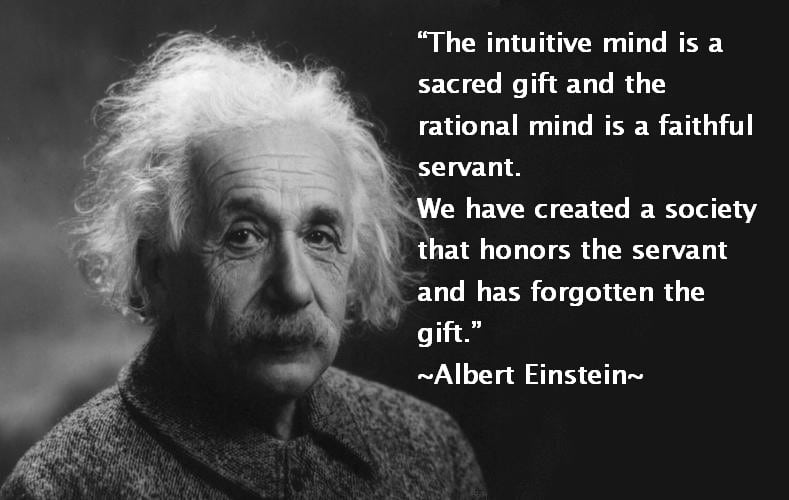
In Zen practice we purposefully cultivate attention in our hara, our belly, our gut. We emphasise turning off our discriminating, thought dominated mind, and develop a kind of knowing that is beyond this’s and that’s, right or wrongs – essentially beyond language itself.
One word in English that we often use to point to this direct knowing is “intuition”.
Intuition is defined as an "almost immediate situation understanding” – a kind of direct, immediate knowing. “How do you know that?” someone asks, and you reply “I don’t know, I just do”. This is intuition speaking. Like a hunch or a feeling. You arrive at a conclusion through processes that typically remain mostly unknown to your conscious mind.
The word intuition comes from the Latin intuir, which means ‘knowledge from within.’ In the last few centuries intuition has been kinda poo-pooed because it’s not rational - it's “just a feeling”. With the rise of science in the West, rational thought has rather taken superiority.
Second brain

Recently there’s been quite a bit of
discussion about what people call our "2nd brain” down in our gut. This 2nd brain consists of sheaths of neurons embedded in the walls of our gut – intestines, stomach, etc. – about 100 million of them in total. That's more than in either the spinal cord or the peripheral nervous system (but a good deal fewer than in our 1st brain!). The feelings from these gut-nerves influence, to quite a large degree, our emotions, so you could say our second brain very much informs our state of mind. One obvious example is when we feel butterflies in the stomach. The butterflies sensation arises as blood is redirected out of our digestive system as part of our
flight or flight response, and it signals to us we’re feeling nervous or anxious. As it
says here, a lot of the information that the gut sends to the (head) brain is about well-being, which is understandable since eating and digestion are fraught with danger! Like the skin, the gut must stop potentially dangerous invaders, such as bacteria and viruses, from getting inside the body.
Intuition is a very undervalued and underused skill in most people. But
interestingly, people with certain types of brain-damage who can’t form emotional intuitions can take hours to decide between two kinds of cereal! They’re caught trying to reason out whether they want Frosties or Coco Pops, and ultimately it’s not a rational decision (any rational person would choose muesli...).
In research, you’ll often start solving a problem by going with a hunch – it’s what sends you off in one particular avenue of enquiry over all the others you could go with. Einstein knew:
The workings of intuition transcend those of the intellect, and as is well known, innovation is often a triumph of intuition over logic. – Albert Einstein
How does intuition arise?
Obviously intuition doesn’t just arise out of nothing. The more experience you have, the better your intuition. Intuition arises out of a rich array of, what you might call, patterns of experience – memories, understanding, learning, observations, that all become integrated into your being.
As Massimo Pigliucci explores in
his book, "these days cognitive scientists think of intuition as a set of nonconscious cognitive and affective processes; the outcome of these processes is often difficult to articulate and is not based on deliberate thinking". In his famous book "
Thinking, Fast and Slow", Nobel Prize winning author Daniel Kahneman notes that "thoughts come to mind in one of two ways: either by “orderly computation,” which involves a series of stages of remembering rules and then applying them, or by perception, an evolutionary function that allows us to predict outcomes based on what we’re perceiving. It is the latter mode that precipitates intuition."
So let's say you're a company executive conducting interviews for a job. You've been at it all morning and none of the candidates have been any good. On paper, the next two candidates have everything and you're excited. The first one interviews very well, comes across confident, gives well thought-out answers, and has great body language. The second one also answers well, is inquisitive, quick, and well-presented.
So who do you choose? From a rational point-of-view, both are equally good, but you just get a feeling that the first one hasn't got what it takes. The feeling arises from your gut (what in Japanese they call the 'hara'), and informs the decision made by your brain.
Intuition in Zen
In Zen, however, we're moving to a place of intuition that's not based on memory, experience, or discrimination. By going beyond just knowing about things to actually perceiving things directly, we come to understand our true nature and in doing so literally become the whole Universe. And if we are the whole Universe, then there's no finding out – we know. We enter the flow of the Universe so fully that the 'knowing' is no longer ours, but an obvious, immediate response of the Universe.
As a teacher, this is a very valuable tool. The more sensitive you are, the more you can enter this flow, and the less our feelings are coloured by our own desires, wishes or judgements, then the more truthfully we can 'intuit' how another is feeling.
Years of training, repetition, beds experience into being,
And from the gut arises direct knowing, a felt sense.
So easily coloured by desires,
Train hard and make discernment clear.
 | I am part of the Zenways sangha led by Zen master Daizan Skinner, and we meet twice a week at our dojo in Camberwell, London. For more info see www.zenways.org |
I'd love to hear from you
If you
've read any of the booked I mentioned, or have any other comments about intuition, I'd love to hear from you. Leave a comment below, join the discussion.
Pass it on
Enjoyed this post? Then please tweet it, share it on Facebook or send it to friends via e-mail using the buttons below.

 Let's say it's raining and I'm trying to decide whether to cycle into town or take the bus. Rationally it would make sense to cycle – it's free, much quicker, and the exercise is good for me. However, I'm a bit tired and I know it's raining and cold, so the bus makes for a very attractive option!