Showing posts with label zen. Show all posts

Friday, 27 January 2017

A person of great strength does not lift his legs

Zen Master Shogen said "A person of great strength does not lift his legs."

The first time I read this I thought it said "does not lift his leg" – well of course! How uncouth, lifting your leg like a dog...

Needless to say, this koan is not talking about peeing on a passing tree trunk. And it goes on to say "and it is not his tongue he speaks with." So what's all this about?

A person of "great strength" is another way of referring to someone who is awake to themselves, who knows their fundamental nature. "Great" here means something like expansive or encompassing. So an enlightened person does not lift their legs, or use their tongue. Does that mean they just sit still, dumb as a stone?

Here's another koan that points in the same direction (and useful for this time of year):

One day a monk asked Zen Master Tozan, "How can we avoid hot and cold?" Tozan said, "Why don't you go somewhere that is neither hot nor cold?"

In this case, the monk then got a chance to ask what he meant.

The monk asked, "Where is a place that is neither hot nor cold?" Tozan replied, "When it is cold, be completely cold; when it is hot, be completely hot."

If we're cold, most of us spend a lot of effort wishing we weren't. "I hate this feeling", "I wish I was indoors", "why can't the turn the heating up?" "I wish I'd worn my thick gloves", etc. The same thing goes when we're really hot. "I'm so hot I can't stand it", "if there was a freezer here I'd get in it", etc.

But if we can simply be cold when we're cold, as Tozan suggests, then there's no problem. There's only a problem is we want things to be different to how they are. Daizan's teacher, Shinzan Roshi, likes to use the term "nari kiru". "Nari" means to become, and "kiru" means cut off – together it means to 100% become one with how things are and to cut off all other wishes or wants. So when we're cold, we nari kiru being cold – then in that moment there is no cold or hot, we simply are, and all concepts of this or that go out the window.

Shogen said "an enlightened person does not lift their legs". Just like being cold, when we 100% nari kiru lifting out legs (say when we're walking), then the concepts of lifting or lowering again disappear. We are just walking.

So the next time you're walking, or indeed speaking, try not lifting your legs or using your tongue...


I am a member of the Zenways sangha led by Zen master Daizan Skinner Roshi, and I teach meditation, mindfulness and yoga at the ZenYoga studio in Camberwell, London. See my website for further details.

I'd love to hear from you

Leave a comment below, I'd love to hear your thoughts.

Pass it on

Enjoyed this post? Then please tweet it, share it on Facebook or send it to friends via e-mail using the buttons below.

Saturday, 27 August 2016

Who are you to decide?

In my previous post I was talking about Peter Levine's amazing book called "In an Unspoken Voice". It summarises what Levine has found over a career of over 40 years in the field of stress and trauma. Specifically I was talking about a section of the book from near the end where he discusses emotions and embodiment.

In this post I'm going to take another aspect from this same section of the book where he talks about change, and the concept of free will.

Free will


As I mentioned in the previous post, at the turn of 19th century psychologist William James concluded that rather than acting because we feel an emotion, we feel the emotion because we are (re)acting.

In his book, Levine discusses how this realisation highlights the illusory nature of perception. He says "We commonly think that when we touch something hot, we draw our hand away because of the pain. However, the reality is that if we waited until we experienced the pain, our hand might be damaged beyond repair. First there is a reflex, then comes the sensation of pain." Makes sense when you think about it...

There have now been many experiments that show that when you "decide" to do something, seemingly of free will, the activity in the brain starts about 1/2 sec (or more even) before you’re consciously aware of making that decision (the first experiment to show this was done in 1985). The brain starts by unconsciously preparing the motor action (springing to life as it were), then the awareness of the decision to move comes, then the action is made.
“Your decisions are strongly prepared by brain activity. By the time consciousness kicks in, most of the work has already been done." – Dr. John-Dylan Haynes (a neuroscientist at the Max Planck Institute for Human Cognitive and Brain Sciences)
William James argued that a person’s passing states of consciousness create a false sense of I or "ego" that runs the show – like a little man (or alien) inside our heads controlling things!

A little man in the head controlling things. From "Men in Black"


When we look at the reality of things, we see this is simply an illusion. The idea that we have a separate self that needs nurturing and protecting is simply not true.

Premovement


Levine suggests that instead of "I think therefore I am" it should be "I prepare to move, I act, I sense, I feel, I perceive, I reflect, I think and therefore I am". (This sounds remarkably like the Buddha's 12-linked chain of causation.)

It's this unconscious preparation for action (or pre movement as he calls it) that's so interesting. Levine suggests that it's "because we are unaware of our environmentally triggered premovement that we falsely believe we are consciously initiating and constructing the movement. Furthermore, when the (unacknowledged) premovement drive is strong, we may feel compelled to fully enact the entire movement sequence." He then gives two examples:

Interrupting the premovement


The first is about his dog, who has a strong instinctual urge to chase other animals (don't they all!). He found that breaking his "habit" by reprimanding him after the chase never worked. However, "if at the very moment his posture changed as he noticed an animal up ahead (hinting at his readiness to leap forward), I would firmly but gently say "No, heel" then he would calmly continue on his walk." So he interrupted his dog in the premovement stage so the action was never carried out.

The other example is a Zen story.

A young, brash samurai swordsman confronted a venerated Zen master with the following demand: "I want you to tell me the truth about the existence of heaven and hell." The master replied gently and with delicate curiosity, "How is it that such an ugly and untalented man as you can become a samurai?" Immediately, the wrathful young samurai pulled out his sword and raised it above his head, ready to strike the old man and cut him in half. Without fear, and in complete calm, the Zen master gazed upward and spoke softly: "This is hell." The samurai paused, sword held above his head. His arms fell like leaves to his side, while his face softened from its angry glare. He quietly reflected. Placing his sword back into its sheath, he bowed to the teacher in reverence. "And this," the master replied again with equal calm, "is heaven."

Transformation


Here the Zen master showed the samurai how to become aware and restrain his rage at the peak of feeling (just as this mind and body were preparing the action), so he could transform his "hell" of rage to a "heaven" of peace.

So here is the key to transforming our habits and moving from unconscious reactions to conscious responses. Bring awareness to the stages of premovement (I prepare, I sense, I feel, I perceive, I reflect, I think) before they graduate into a full-blown movement sequence. In Buddhism they say "to cool and extinguish the glowing embers before they ignite into a consuming flame".


I am a member of the Zenways sangha led by Zen master Daizan Skinner Roshi, and I teach meditation, mindfulness and yoga at the ZenYoga studio in Camberwell, London. See my website for further details.

I'd love to hear from you

Leave a comment below, I'd love to hear your thoughts.

Pass it on

Enjoyed this post? Then please tweet it, share it on Facebook or send it to friends via e-mail using the buttons below.

Wednesday, 17 August 2016

What is an emotion?

I've recently finished reading a book by Peter Levine called "In An Unspoken Voice". It's a pretty amazing book – the result of a career of over 40 years in the field of stress and trauma, detailing his pioneering work into how trauma happens and the methods he's found to work with it. Coming out of these methods is the therapeutic body-awareness approach to healing trauma called Somatic Experiencing that's now available across the Western world. (If you're interested in this area, Bessel van der Kolk's "The Body Keeps The Score" is also well-worth a read.)

Towards the end of "In An Unspoken Voice", Levine touches on the subject of emotions and embodiment, and that's what I wanted to pick out to talk about in this and the next blog post.

What is an emotion?


It's simple to ask, but very tricky to answer!
If your everyday practice is open to all your emotions, to all the people you meet, to all the situations you encounter, without closing down, trusting that you can do that - then that will take you are far as you can go.  And then you'll understand all the teachings that anyone has ever taught.
– Pema Chödrön
As Levine points out, Descartes claimed "I think therefore I am" and it seems many people might agree with him. With this in mind, when something provocative happens you might think that your brain recognises this provocation and produces an emotional response. Then the brain tells your body how to react in accordance with this emotion: maybe increase heart rate, breathing, tense muscles, etc. What do you think? Does this seem like the way it works in your experience?

At the turn of 19th century, experimental psychologist William James took a different approach and arrived at a different conclusion. Through introspection, he would attempt to infer the chain of events that led to an emotion being generated. Most of us might think that when we see something scary we get frightened, and then motivated by fear, we run. Through his studies, James concluded the opposite – that rather than running because we are afraid, we are afraid because we are running. We feel sad because we're crying, feel happy because we're smiling, etc. The emotion comes as a result of the (re)action.

James was remarkably ahead of his time, and the importance of his work is only just being appreciated now.

Emotion is an afterthought


Emotion doesn't originate in the brain – it's the brain's perception of the body's reaction that generates the emotion. As Levine puts it "it's almost as if the brain canvases the body to see how it's reacting in the moment" (or in reality, assesses all the information it's receiving about the sensations and state of the body) and calls that collection of sensations and actions an emotional state.

Emotions happen in the body – they are 'embodied' processes. Levine has a lot to say about embodiment – he defines it as "gaining, through the vehicle of awareness, the capacity to feel the ambient physical sensations of unfettered energy and aliveness as they pulse through our bodies." Gut feeling, precognition, and what we call intuition, then "emerges from the seamless joining of instinctual bodily reactions with thoughts, inner pictures and perceptions."

"Mu shin" calligraphy

No-mind, no emotions


This sounds remarkably Zen! In fact it sounds like the Zen idea of "no-mind" (mu-shin), which means being directly in touch with the experience of now (and acting from that place), without concepts, ideas or mental commentary getting in the way.

And as my teacher Daizan Roshi says, "when you're on the cutting edge of reality, there are no storylines or thoughts" – or indeed emotions. Emotions are simply our labels for patterns of specific thoughts, sensations, reflexes and actions. "Its only when we look back with hindsight," Daizan continues, "that we try to make sense of things and the story-lines come."

Or as Charlotte Joko Beck puts it in her book, "Behaviour is what we observe. We cannot observe experience. By the time we have an observation about an event it's past – and experience is never in the past. That's why the sutras say we can't touch it, see it, hear it, think about it – because the minute we attempt to do that, time and separation have been created. ... Who I am is simply experiencing itself, forever unknown. The moment I name it, is it gone."

When you're truly, directly experiencing that moment of feeling happy (i.e. on the cutting edge, as Daizan puts it), there are no thoughts about it. There's just... it.


I am a member of the Zenways sangha led by Zen master Daizan Skinner Roshi, and I teach meditation, mindfulness and yoga at the ZenYoga studio in Camberwell, London. See my website for further details.

I'd love to hear from you

Leave a comment below, I'd love to hear your thoughts.

Pass it on

Enjoyed this post? Then please tweet it, share it on Facebook or send it to friends via e-mail using the buttons below.

Friday, 22 July 2016

Dharma combat

The Hossen ("ho" meaning Dharma in Japanese, and "sen" meaning combat or challenge) was my third and final ceremony for becoming a junior-level Zen teacher. The main point of the ceremony is to allow a teacher to demonstrate their embodiment of Zen, and to give the sangha a chance to test them out. If they're going to become a new teacher, do they think they're up to it? Can they talk as the Dharma, not just about it?

A complicated ceremony


The dojo full of people
Despite the simple intention, the details of the ceremony were a bit more complicated. It started with a short introduction from Daizan, then we chanted the Hannya Shingyo (Heart Sutra). I then read out the koan I'd chosen and gave my talk on it (I posted about that in my previous article), then everyone in the audience got a chance to ask me a question. It finished with me reciting the 4-line verse I'd composed summarising my understanding of the koan, and Daizan giving a short summary to finish.

Where it got complicated was around how all these aspects fitted together. So Daizan told me, the whole thing is designed not to give me (the aspirant teacher) a moment to think – and therefore the potential to worry and get caught up in the world of thoughts, ideas and discrimination. From the beginning I was holding my teaching fan – a traditional symbol of a Zen teacher called a chukei. There was a special way to hold it which I had to be mindful of at all times. There was also a very specific way I had to collect my teaching book, and I had to start my talk on the very last syllable of the Hannya Shingyo chant so as not to leave a moments gap. As soon as I'd finished I had to ceremonially take my teaching book back to Daizan, perform a number of bows, and collect our dojo's shippei (staff/stick; see photo below) and come back to my place. Once the questions started, I was encouraged to answer every one, again, without a moments gap or silence.

As I was reading out the koan, I was conscious of speaking from the hara. As I'd spent quite a while preparing the talk, I felt quite ok following on from the koan and giving the main talk. I think I managed to continue speaking from the hara, and I even got a laugh or two at some point!

No questions and no answers


Collecting the shippei from Daizan
Once the talk had finished and I had collected the shippei and sat down, I banged it hard on the ground and said "What say you?". This was my appeal to the sangha to ask me their questions. Pete Jion Cherry, my assistant, was the first questioner. The format was for the questioner to start by saying a loud "Here!" (to indicate where they were sitting) then give me their question. I would then bang the shippei on the floor and gave my answer. If they thought my answer was sufficient they would say "congratulations" – otherwise they were allowed to ask me to explain or ask a further question. After the "congratulations" I was to bang the shippei again and say "I thank you". Then the next question would start with "Here!". All this was supposed to happen with the minimum hesitation or silence.

We had about 35 people in the room, so the questioning took a while. Some were very short and some I gave just one-word answers, some had some further questions. There were certainly moments when there was literally no questioner and no responder – the emptiness and no-knowing that Bodhidharma refers to in the koan were manifest in the room. There were also other moments when I could feel the spinning up of my thinking mind, wanting to assert control and work out how to answer the question, worrying about what the "right" answer was.

Looking back I can't really remember the actual questions or my answers – I feel like it all happened without being registered in my normal memory!

I have a feeling something changes in the way memory works and the way you perceive time when you're in that true place of oneness – where intuition and instinct are master, and logic and reasoning are in their rightful place as servants. Its like trying to remember what happened in meditation, or during a period where time "just flies". The memory becomes more related to feeling and action than thought and storyline. Luckily we videoed the whole thing (I'll post that up soon)!

After it was all over, people were asking me how it felt. It felt simultaneously really hard work and totally effortless. Maintaining that energy and resisting the temptation to let my reasoning mind take over was perhaps the hard part. Letting the truth speak through me was the effortless part. In essence there was no me – the answers just flowed out of the universe through my mouth.

What happens now?


I'm now officially a lay Zen teacher. What that means is for us all to find out in the coming years. My intention is to stay open to whatever opportunities or situations arise, and do my best to simply act. Let's see what happens...


I am a member of the Zenways sangha led by Zen master Daizan Skinner Roshi, and I teach meditation, mindfulness and yoga at the ZenYoga studio in Camberwell, London. See my website for further details.

I'd love to hear from you

Leave a comment below, I'd love to hear your thoughts.

Pass it on

Enjoyed this post? Then please tweet it, share it on Facebook or send it to friends via e-mail using the buttons below.

Monday, 18 July 2016

My first dharma talk

In the last few weeks I've been describing the ceremonies I have to pass through in the Zenways school in order to become a junior-level Zen teacher. There are three in total: the private "kechimyaku" ceremony, the public "hodo" ceremony, and the last is called Hossen, literally meaning Dharma combat.

On Sunday 17th July, we had the last of the three ceremonies, the Hossen-shiki, at the dojo in Camberwell. The format of the ceremony was that I would come in with my assistant (the solid Pete Jion Cherry), read out the koan I was going to talk about, then give a talk about it. Then every member of the sangha present in the room would have an opportunity to ask me a question about what I'd said (or about anything else), then I would finish by reciting a 4-line verse I'd composed summarising my understanding of the koan.

In my next post I'll talk about how it went and my experience of it. For now, here's the contents of the talk and my 4-line verse.

Koan


Emperor Wu of Liang said to Bodhidharma “I’ve built many temples, copied innumerable sutras and ordained many monks since becoming emperor. I ask you, what is my merit?” Bodhidharma replied “No merit.” The emperor asked “What is the first principle of the holy teachings?” Bodhidharma said, “Emptiness, no holiness.” The emperor asked “Who is this standing before me?”, Bodhidharma answered, “No knowing.” The emperor did not grasp his meaning. Thereupon Bodhidharma crossed the river and went to the land of Wei.

The emperor later spoke of this to Shiko (his most trusted priest), who said, "Do you know in fact who this person is?” The emperor said, “No.” Shiko said, “This is the Bodhisattva Kannon, the Bearer of the Buddha’s Heart Seal.” The Emperor was full of regret and wanted to send for Bodhidharma, but Shiko said, “It is no good sending a messenger to fetch him back. Even if all the people went, he would not turn back.”

Talk


Let's start with a bit of background. The emperor was a serious and committed student of Buddhism. It seems Bodhidharma's reputation as a Buddhist teacher had preceded him since the emperor had asked him to visit the Imperial Palace as soon as he arrived from India.

No merit


The exchange starts with this whole idea of merit. The emperor proudly lists all the good deeds he's done and asks how much merit he had accrued. Bodhidharma said flatly “no merit”. So it might be a good idea to start by looking at this idea of merit. As far as I understand, merit is a kind of Buddhist technical term meaning “the effect or consequence of doing good things”. Traditionally one can gain merit through giving or generosity, and the cultivation of virtue (patience, tolerance, etc.) and insight or wisdom.

The Chinese at this time had become quite captivated by the idea of merit and of the idea of karma (the law of volitional action and consequence). So the emperor had been building stupas, supporting monasteries and ordaining monks, assuming that these would all count as “good things” and that he would accrue merit as a result. Of course they were all good things – but why was he doing them? What was his underlying intention? Bodhidharma saw it straight away.

Have you ever come across the idea that when you die you’ll arrive at the gates of heaven and St. Peter will open up his great big book and read out a list of all the good and bad things you've done in your life? Depending on how it adds up he’ll either unchain the gates of heaven and let you in or send you off down to hell and eternal damnation. I was looking this up the other day an apparently it's entirely baseless in Christian scripture – the bible doesn't actually say that. It's a horribly misconstrued version of “judgement”. But it's out there in common culture and probably most of us have heard of it in one way or another! In the same way as this idea is a misunderstanding of the Christian teachings, Emperor Wu had similarly misunderstood the Buddhist teachings.

This mentality also persists in the Father Christmas myth – and kids get this drummed into them at a very young age. In the run up to Christmas, Santa tots up all the good and naughty things children have done over the year and only comes down the chimney to drop off a present if they’ve been good enough. So the child grows up thinking someone is always keeping a tally.

Then as adults we end up having thoughts like “when will I get what I'm owed?” or “I’ve worked so hard, surely I deserve that promotion…” All this comes from this same misperception – that we've accumulated enough merit on our balance sheet to get what we want.

Conditional love falls into this category too. I was in Greece recently and someone said “the love of a Greek mother is complete and "unconditional"... except that you're not allowed to escape it!” Loving someone conditionally, i.e. with strings attached, is about wanting something back in return.

Keeping a balance sheet and wanting something in return can only happen if we perceive there is a “self” to win and an “other” to lose. It's rooted in the world of separation. “I” want this, because “I” want to feel better. This was exactly where the emperor was coming from.

So the emperor was hoping for praise and recognition when he asked how much merit he’d accrued – but he got a sharp "no merit".

Ok then, fancy teacher from India, if doing "good" things isn't enough by your standards, "what is the 1st principle of the holy teachings?" Bodhidharma answered again with a very pithy retort "Emptiness, no holiness".

Who do you think you are?


The emperor was perhaps now completely confused and frustrated. Whatever he thought Buddhism was about, he was being told it's not. He'd understood Bodhidharma was a great teacher, but none of what he was saying was making any sense. Bodhidharma was refuting everything and I’m guess the emperor's ego was feeling pretty hurt. So he asks "who are you then?" or perhaps "who do you think you are?"

Again he gets a seemingly ridiculous answer – "no knowing." And that's the end of the conversation! Who knows, maybe the emperor chucked him out at this point, or maybe he just let him go thinking he's worthless.

Later the emperor goes to see his most trusted priest, who says “do you know who that was? It was the Bodhisattva Kannon – the embodiment of compassion – and bearer of the Buddha’s Heart Seal”. At that the emperor was full of regret – "I didn't understand... If you, my most trusted priest hold him in such high regard then I should talk to him more – Can you get him back?" But the priest says nope, he's gone and won't come back now. It was a one-time opportunity.
 

Nari kiru Bodhidharma


The character of the emperor is equivalent to our small, suffering selves – the one that's caught up in concepts and ideas, especially the one thinking we have a separate self. We look for something outside of ourselves to ease our suffering – if I do this, or get that, I'll be better or happier, or get enlightened…

Now let's try and stand in the shoes of Bodhidharma – nari kiru Bodhidharma, literally become Bodhidharma. If the emperor represents our small, limited self, then Bodhidharma represents our true Self – unlimited and one with the whole Universe.

The emperor asked, "how much merit have I accumulated?" Bodhidharma saw that his “good deeds” had been motivated by self-interest – by a belief in a separate "I" that can win merit. Basically he was asking, "have I done enough to go to heaven (Pure Land)?" Bodhidharma cut straight through that. “No merit” – “I” doesn't accumulate merit, because “I” doesn’t exist in the way you think it does.

But we all fall into this trap, all the time – expecting to be recognised for what we do. Giving and wanting something in return.

True merit comes from the pursuit of knowing who we really are – finding out our true nature – and from the spontaneous actions that arise from that place. Ultimately there is no giver and no receiver of merit. Which is exactly the next point.

Emptiness, no holiness


Confused that accumulating merit isn’t the main point of Buddhist practice, the emperor asks, ok then "what's the main point of the holy teachings?"

"Emptiness". Again, it’s another technical term if you like. But it’s the absolute crux of Zen – everything is changing, there are no things and no fixed ideas, nothing arises independently. And because everything is changing, things are empty of a fixed “essence” or permanence.

Then Bodhidharma, man of few words, elaborates on this. He says “No holiness". Seeing the emperor is the kind of guy, like all of us, that grasps onto ideas, he cuts straight through any inklings he might have that this teaching was 'holy'.

It's all too easy to get caught up thinking that the Dharma is something holy – that it's to be held up on a pedestal or revered, even worshipped. Again, we all do this. What do you hold up as "holy"? Something that's special, to be revered or held in especially high regard in your life? Your iPhone? Your partner? Your Zen teacher (Daizan)? Enlightenment itself? The Buddha? Is the Buddha holy? There’s that great phrase in Zen “If you meet the Buddha on the road, kill him.”

No knowing


Exasperated and frustrated, the emperor asks "Who is this that stands before me?"

“No knowing.” Bodhidharma again speaks the absolute truth. He doesn't let up in his attempts to teach the emperor. It's not a no-knowing like "I haven't a clue" – he didn’t have amnesia! He wanted again to make the point that on the absolute level, all thoughts, ideas and concepts are fundamentally empty – there's nothing to know. Bodhidharma isn’t a fixed thing, he’s a process, a flow.

So "not knowing" is exactly the same as "emptiness" – it's the first principle of Buddhism.

Summary


In this whole exchange, Bodhidharma embodies the classically Zen approach of ‘tough love’ – the old priest knew that when he described Bodhidharma as Kannon, the embodiment of compassion. The kindest thing to do is tell it straight. No beating around the bush and prolonging his agony!

It’s like Bodhidharma is doing everything he can in this to point at the truth. "It's not this, not that, not that either. Here's the truth, here..." His fingers are pointing from every direction at the truth! But the emperor is still saying "Where? Where? I don't see it". After doing all he can, being as direct as he can, Bodhidharma just leaves!

So as we come to do our meditation practice, I invite you ask yourself “who is this that stands here?" – or who am I that sits here?

When you truly have no idea of who that is, you will be Bodhidharma. You will be all the ancestors. You will be the whole Universe. And in that, can you find an "I" to accumulate merit?

Verse


Merit made into a jewel,
Smashed with words as the tool.
No merit, knowing or idea
Gives freedom and life without fear.


Having tea in the dojo after the ceremony


I am a member of the Zenways sangha led by Zen master Daizan Skinner Roshi, and I teach meditation, mindfulness and yoga at the ZenYoga studio in Camberwell, London. See my website for further details.

I'd love to hear from you

Leave a comment below, I'd love to hear your thoughts.

Pass it on

Enjoyed this post? Then please tweet it, share it on Facebook or send it to friends via e-mail using the buttons below.

Thursday, 14 July 2016

Raising the Dharma Banner

In my last post I talked about my experience of the first of three ceremonies I have to pass through to become a junior Zen teacher – the Kechimyaku (lit. bloodline) ceremony.

In this article I want to describe the next ceremony called the Hodo-shiki, and the first of the two public 'exams'.

Hodo literally means "dharma banner" and refers to the times when temples would put up a flag or banner to advertise when a visiting teacher was giving a talk on the Dharma. In our Zenways school, a Hodo-shiki (ceremony) is when a prospective teacher is tested on their intellectual knowledge of the Dharma (as opposed to their embodiment of it, which will be tested in the next ceremony, Hossen-shiki). It's a bit like a PhD viva – and it's been almost 10 years since I did one of those!

On 26th June I did my Hodo-shiki at our dojo in Camberwell in front of the sangha. In the preceding weeks I'd been revising my basic knowledge of the Dharma, based on the last few years of reading the study book list (given here). Some of my fellow trainee teachers had been sending me test questions to answer, and Daizan Roshi had also given me a list of sample questions to study. I felt reasonably confident on the test questions, but was acutely aware Daizan could ask me literally anything.

The ceremony started with me making my bows and then chanting the Hannya Shingyo (Heart Sutra) by myself. I was a touch nervous, and although my voice came out clear and steady my memory was obviously affected. I was aware somewhere in the first quarter of missing a few syllables (miraculously without missing a beat). I felt disappointed that I messed it up because I know it well! That was just the way it was – nerves have that effect.

Then I had to say "I wish to be a teacher of the Dharma. Please test my knowledge." And off we went with the questions. Daizan was sitting at one end of the dojo, and me at the other. Thankfully he didn't ask anything out of left field. He asked a few of the "name the 6 whatevers and 10 whatever elses" that Buddhism is full of (in my case the parameters and the precepts). He also asked a couple of questions more specific to me considering my background in physics – "do people use quantum mechanics to help explain the Dharma, and how successful are they?" (That'll be the subject of a future post!)

At the end he said "you've done well" and that was the end! Here's a link to the video of the ceremony where you can hear all the questions I was asked.


Although being a Zen teacher is really about being the truth and speaking as that truth (not talking about it), there's an obvious wisdom to a ceremony like this. As I become a teacher there are some basics I need to know regarding what the Buddha taught, and the history and context.

The session finished with about 40 mins of zazen (sitting meditation) and our usual tea and chat afterwards.

In my next post I'll talk about the final ceremony – the Hossen-shiki – where I have to demonstrate my ability to speak as the Dharma. If you're free to come along to it this Sunday, please do! The more the merrier!


I am a member of the Zenways sangha led by Zen master Daizan Skinner Roshi, and I teach meditation, mindfulness and yoga at the ZenYoga studio in Camberwell, London. See my website for further details.

I'd love to hear from you

Leave a comment below, I'd love to hear your thoughts.

Pass it on

Enjoyed this post? Then please tweet it, share it on Facebook or send it to friends via e-mail using the buttons below.

Friday, 8 July 2016

On the path to becoming a junior Zen teacher

In our Zenways lineage, becoming a Zen teacher happens in three stages: junior Zen teacher, senior Zen teacher and Zen master (or Roshi). Our Roshi, Daizan, likens the process of becoming a Zen teacher to an apprenticeship. It's not a structured course, or even a well defined learning journey, but individual to each person and taken at a speed directed by them.

I've been on the programme for a few years, and back in February Daizan told me he thought I was ready to do the junior-level ceremonies. I knew his would be a great honour so we went ahead and booked in some dates. 

The first one I did was called the Kechimyaku ceremony (I don't think it has to be the first one – just happened to be in my case) starting on Monday 20th June and running through to the summer solstice on 21st. In Japanese, "kechi" means blood and "myaku" means line or channel. The main emphasis of the 2-day long ceremony is to write out our Zen lineage (or "bloodline" of master-to-student) stretching all the way back to the Buddha, and take my place within that (the image shows a small part of a kechimyaku – this one is written in Chinese characters but mine was written in English).

Part of a kechimyaku written in Chinese. It starts with
emptiness, then comes Shakumuni Buddha, then all
the rest of the ancestors.
As Daizan was telling me, historians can find holes and inconsistencies in the official lineage all over the place! – in the succession of Indian masters in the centuries following the Buddha, in the line of ancient Chinese masters, and in the Japanese line too. That's not the point. The point is that each of these masters realised the truth of their Buddha-nature, and once you do that you become Buddha – you become all of the ancestors – and then the lineage is just a mark of gratitude to all those that have carried the torch down through the centuries. 

Notable in their absence, though, are the women "torch-bearers" (for a great book on this see Hidden Lamp). Only one woman appears in our lineage: Rev. Jiyu Kennett Daiosho (d. 1996) who was the founder (1972) and abbot of Throssel Hole monastery in Northumberland, England, where Daizan studied in the Soto tradition for many years. The absence of women only reflects the dominant male monastic culture throughout India, China and Japan for the last millennium, not their ability to realise enlightenment. The Buddha himself always said women can achieve equal levels of insight to men.

The kechimyaku ceremony has five components: (1) asking, (2) san-ge (purification), (3) taking your place, (4) writing out the kechimyaku lineage, and (5) endless bowing. 

The asking part involved some ceremony and symbolism around arriving into the space, and me formally asking Daizan to become a Zen teacher. Sange (pronounced san-gay) means "regret" (san) and "resolve" (ge), referring to acknowledging past harmful actions (the things you regret) and the committing never to do them again (resolve). 

In the "taking my place" section I was asked to sit in meditation for 3hrs without moving. This represents the resolve made by the Buddha before his enlightenment – "if only my skin, sinews and bones remain and the flesh and blood in my body dry up, I will not move from this place until I realise complete enlightenment". The 3hrs was about exploring that steadfast stillness and resolve.

Sitting for 3hrs in stillness wasn't easy. Daizan told me a few months ago to start preparing so I  had been slowly building my way up to the full length. I saw it like a marathon, so trained using an adapted marathon training schedule (where I replaced running distance with time)! I'd tested out a few different postures and found kneeling with a bench to be ok, and the week before my ceremony I'd done 2h30 like that. I'd generally start off with a breath counting meditation, counting to 100 a few times to stabilise and still my mind. Then I'd let go of the breath and sit in the Unborn (open presence. If my thoughts began to wander again, I'd come back to the breath counting for another few 100. I was finding after about 1h30, things would get very still indeed and almost pleasurable (I think people call this a dhyana/jhana state).

During the ceremony, however, I was sitting with my bench on a carpet rug, which (at about 15mins in) I realised wasn't as soft as the zabuton I was used to. The knobbles on my knees got very painful – excruciating at points. Nevertheless I did find some internal stillness after about 2hrs. At this point I basically just gave up trying to make the pain go away. As I stopped wanting things to be different, the suffering ceased – it's a good lesson to be reminded of.

The next part was a kind of retreat involving the writing out of my kechimyaku and a ceremony around embodying what it truly means to be a teacher. After some more meditation and many bows (the 5th stage of the ceremony), we finished sometime in the early evening. I'd been given my junior teacher Rakusu and teaching fan. Now all I have to do is prove my worth in the next two public ceremonies...

Next week I'll tell you a bit about the next stage, the first of the two public ceremonies for testing my knowledge of the Dharma called the Hodo ceremony.


I am a member of the Zenways sangha led by Zen master Daizan Roshi, and I teach meditation, mindfulness and yoga at the ZenYoga studio in Camberwell, London. See my website for further details.

I'd love to hear from you

do you have an experience of sitting still for a long period? Who do you consider to be your Dharma ancestors? Leave a comment below, I'd love to hear your thoughts.

Pass it on

Enjoyed this post? Then please tweet it, share it on Facebook or send it to friends via e-mail using the buttons below.

Thursday, 8 October 2015

Zen pilgrimage walk: Sleeping rough

Earlier this summer I did a 4-week pilgrimage walk through the country as a Zen monk – carrying no money, just living from my alms bowl. So far I've written a number of articles about the walk (including why I would even do such a thing, the pain in my feet, and how I lived from the bowl on people's generosity).

In this post I'd like to share a little bit about the nights when I didn't have anywhere planned to stay.

The route for my journey was organised around people and places I wanted to visit. But I didn't have a bed lined up for every night. The other nights I had to have to find shelter for myself.

I've done some wild camping in my time, both here and abroad – but that was always with a tent. On this trip I took only a sleeping bag and a roll mat so on those nights I didn't have a bed, I had to find somewhere under-cover to protect myself from the elements.

The first rough night

The Post Office sorting office in Fordingbridge

The first night I slept rough, I ended up in a lovely small town called Fordingbridge in Hampshire. That evening I limped into town with my feet hurting to such a degree that I couldn't spend ages searching around for a place. After a short recce up the high street I spotted a covered porch outside the post office building. Actually it was a sorting office and parcel collection place, and the front of the building had a ramp up to the porch with a door in the corner that looked very unused. There were cobwebs all over it. It was ideal – a good roof, mostly hidden from the road, and not too dirty.

As I unrolled my mat and sleeping bag, I took note that the office opened at 6am, so I set my alarm for 5:15 to make sure I was up and out of there – just in case.

The town quietened down by about 9:30-10pm, with only the occasional car carrying it's driver up to the chippie round the corner. It was strange to hear the road so loudly as I was dropping off, and I think I remained quite vigilant to being noticed for quite some time. Eventually I fell asleep.

I woke up with the alarm. Just as I was rolling up my mat at about 5:45 the door in the porch started to unlock. Shit... I was convinced they're going to shoo me away and report me to the police! But so what if they did? – that would just be part to the pilgrimage. But I didn't think like that at the time.

So the door opened and out leaned a postie. "Do you want a cup of tea?" he asked. I was blown away! "That'll get you warmed up for the day!" he continued. Wow! So I sat there drinking my tea in a warm glow of incredulity and gratefulness to the kind postman.

That's how it continued really! I slept in someone's garage, under some scaffold, in the awning of a disused cafe, in a church doorway. I never had any major problems finding shelter.

The night of the Waitrose bridge


One evening I was walking into Newbury. On these days where I knew I didn't know where didn't know where I was going to sleep, the anxieties usually started arising at about 3-4pm when I still had a few hours walking to go. First would come the (re-)realisation that I didn't know where I was going to sleep that night. Then would come the thoughts – could I sleep in that bus stop if I had to? What if I was in deep suburbia and there was nothing but rows of houses? Where would I find then? That place looks good, but I can't stop now, it's too early. What if I can't find anywhere? Etc, etc.

Walking into Newbury I remember checking out some hedgerows, and some emergency stairs at the back of an office block. Them, as I was walking past a brand new Waitrose I noticed they had a delivery entrance on the other side of a short bridge. I surreptitiously snuck through some undergrowth to have a look under the bridge and happily found a nice bit of fairly clean, flat concrete between two pillars. I unrolled my mat as you can see in the photo.

A while later as I was in my sleeping bag, just nodding off, a couple of homeless people brushed past. I pulled up my head and the lady said "alright mate, we won't be long." They went round the corner and proceeded to have a blazing argument with lots of effing and blinding. This was the only time on the walk where I really felt vulnerable. Should I leave? It would take me at least 15mins to get dressed and pack up my stuff, and it would be very obvious to them what I was doing. I decided to just keep my head down. To them I was probably just another homeless guy – why should they bother me? And they said they wouldn't be long...

The argument continued for some time – but they did leave eventually. It was a strange feeling to drop off to sleep in that situation. I kept telling myself to relax, and whatever was going to happen would happen. Trust in the universe! I had an alright nights sleep in the end. The canal my route was
following was only 30secs walk away and it was a beautiful morning.


The night of the Church Doorway


Later on in the walk, I was looking for a place to kip in Balsover, Derbyshire. After some time looking around the edges of the town, I spotted a church doorway. I'd often stopped in church porches for breaks or to shelter from the rain, so when I saw this doorway I felt compelled to investigate!

As I approached, an older couple came out of an adjacent doorway of the church. I had to explain myself: "I'm a Zen monk... Would you be ok if I slept in this doorway?" They weren't exactly encouraging, but said it would be fine – as long as I didn't do any graffiti or get caught by the police.


What I learned


Before this walk I'd never slept rough. Granted when I was on my walk it was summer, and the nights weren't too cold, but I found it a surprisingly comfortable and very liberating experience. By the end of the walk I had quite a good eye for spots to shelter in – both in the town and out. My absolute ideal place to sleep would've been a barn full of hay. I actually found one once, but sadly it was the middle of the day at the time. Only once did I feel slightly vulnerable, but that was just my anxiety towards strangers. I should've just got up and had a chat to them.


I am a member of the Zenways sangha led by Zen master Daizan Roshi, and I teach meditation, mindfulness and yoga at the ZenYoga studio in Camberwell, London. See my website for further details.

I'd love to hear from you

Ever had a similar experience? Leave a comment below, I'd love to hear your thoughts.

Pass it on

Enjoyed this post? Then please tweet it, share it on Facebook or send it to friends via e-mail using the buttons below.

Thursday, 10 September 2015

Zen pilgrimage walk: Wisdom of the robes

I recently got back from a 4-week pilgrimage walk through the country, which I did as a Zen monk – carrying no money, just living from my alms bowl. In the first article in this series I talked about why I would even do such a thing, then I discussed the pain in my feet and how I dealt with it. Last week I talked about living from the bowl and the wonderful generosity I found along the way.

This week I want to focus on what I was wearing and the wisdom I found within it. Will you stay with me? (couldn't resist the alliteration!)

No, I don't mean Daizan had tucked a booklet of Zen wisdom into the folds of the robe for me to find (sadly!) – I mean the wisdom embedded in the design and material of the outfit.

The robes


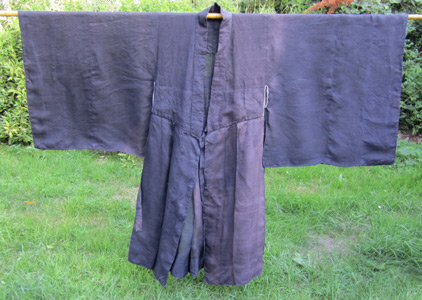
If you had to wear one set of garments for travelling on the road, and you weren't going to add or take away any layers, then the monk's robes I had weren't far off the ideal. There are three layers: the undergarment is called a jubon and is equivalent to a shirt. It's waist-length and folds over the body in the traditional Japanese way. The second layer is called a kimono and mine was grey (can also be white). This, again, folds over in the same way, but is full-length down to my ankles. These two inner layers, folded around the body, are held together with a wide, elasticated belt called an obi. The third layer is the outer koromo, made of a kind of denim material (indigo hemp I think) that comes down to about mid-calf level, has large sleeves, and has ties at either side at the waist to fasten it.

Traditional Rinzai Zen monk's travelling clothing

Another belt called a shukin is wound around the waist to hold everything together (more on that below). The lower part of the robes could be hitched up underneath the shukin (on warm days or to make walking easier), and the long sleeves could also be tied up at the shoulders (again for warm days).

Robes with the sleeves tied up, showing the shukin belt with the rakusu tucked behind it.


Shukin


The skukin (meaning "hand cloth" in Japanese) is a very interesting part of the robes (the Soto school has a similar rope belt called a shiken). I haven't been able to find out much about its origin, or why it's tied in such a way (some info here if you want to dig). At first it seemed an unnecessary weight and a bit of a hassle, but as time went on I began to see the deep wisdom embedded in it.

After a few days of walking I noticed that I wasn't feeling that hungry during the day. It was only when I stopped for the night and undid my robes that I started feeling hunger pangs.

Influenced by the monastic culture at the time, the Buddha only ate breakfast and lunch, and in fact made a rule that his monks shouldn't eat after midday. Monks in the Buddha's day also didn't work or cultivate the land, relying only on alms food. As Buddhism spread north into China, the Chinese weren't so happy with supplying the monks with 100% of their food, so they began farming the land around the monasteries. The colder climate and the extra work meant monks had to eat more (and wear more). To begin with, they kept with the 'no eating after midday' rule, and in the evenings the monastery kitchens gave out hot rocks that the monks would put on their stomachs to assuage their hunger. As Zen spread into Japan, they relaxed the after-midday rule, and the (still unofficial) evening meal became known as yaku seki (meaning "medicine stone").

So the pressure and warmth of the shukin belt against my belly as I was walking must have been doing the same job of stopping any hunger pangs.

The other effect I noticed was that it really helped bring my attention to my hara. In a way it felt like a weight-lifters belt, but swivelled around 180deg. It held everything in, and gave my abdomen something to breathe against. I could feel the swell of my breath against the shukin in the front of my belly, in my sides, and in my lower back, and this really helped me in continually relaxing my belly with each breath (see my article on pain). By resting my attention in my hara (and tanden particularly), I could also build my energy there, helping my feel more grounded and stable.

Hat


The hat (kasa or ajiro-gasa in Japanese) I had is of the traditional conical type found all over East Asia. It's made of woven bamboo and coated in the traditional way to make it waterproof – by using Persimmon juice (not by me I hasten to add). I found it a very effective umbrella in the rain, and a great sun hat on sunny days. The only problem was that it wobbled and often slipped forwards over my face with just a breath of breeze! Without the shoe-lace chin strap, the hat would for sure be lost in a hedge or ditch by now.
Me in the rain cape (in the Yorkshire rain -
looking surprisingly chipper)


Rain


I had "the official" Rinzai rain cape with me on my journey, which was big enough to cover pretty much everything including my rucksack – see photo. The only thing that got wet were my feet, and on rainy days these really got very squelchy...


Rakusu


The rakusu is worn around the neck and hangs, a bit like a bib, over the chest. It is a miniaturisation of the traditional kesa (or outer robe, originally worn by the Buddha). The story goes that the Buddha was out walking one day with his assistant Ananda. As they crested the top of a hill and looked down on the patchwork of rice paddies in the valley below, the Buddha said to Ananda, that's how I want our robes to be – a patchwork of cloth cut into a square. This pattern symbolises the "all is different" aspect of reality, together with the "all is one" aspect, and is maintained in the design of the rakusu. The white disk on the left strap is a left-over from the clasp that fastens the large kesa around the body.

I was given my rakusu when I first took the precepts as a lay person back in 2011. On the back is a white patch which has my first (lay) Dharma name (Kakushin) calligraphed onto it by Shinzan Roshi.


Footwear


I discussed my footwear in this previous article. Of everything that happened on the walk, the pain from the footwear taught me the most. For this I am extremely grateful.


I am a member of the Zenways sangha led by Zen master Daizan Roshi, and I teach meditation, mindfulness and yoga at the ZenYoga studio in Camberwell, London. See my website for further details.

I'd love to hear from you

Ever had a similar experience? Leave a comment below, I'd love to hear your thoughts.

Pass it on

Enjoyed this post? Then please tweet it, share it on Facebook or send it to friends via e-mail using the buttons below.

Friday, 4 September 2015

Zen pilgrimage walk: Generosity and living from the bowl

I recently got back from a 4-week pilgrimage walk through the country, which I did as a Zen monk – carrying no money, just living from my alms bowl. In the first article in this series I talked about why I would even do such a thing, and last week I discussed the pain in my feet and how I dealt with it.

This week I'd like to talk about one of the most beautiful aspects of the experience – how I lived from the bowl and some of the incredibly generous people that filled it along the way.

Bournemouth


On day two I found myself in the centre of Bournemouth in the town square, just at the end of the gardens leading up from the beach and pier. I'd been walking along the sea front in beautiful sunshine and the whole place was buzzing with people eating ice creams. I'd been given enough food when I left for my first day of walking, so now I needed to gather some food for the onward journey. I'd headed towards what I thought was the busiest shopping area to stand with my bowl for the first time.

Bournemouth square
I sat down on a wall at the edge of the square trying to assess where the best place to stand might be – at the edge or right in the middle? – in front of the cafe or a little away from it? Once I'd selected a spot I thought "right, let's do this," but my body didn't move. "Ok, really, let's get on with it..." – still no movement. What was the resistance? I dropped my attention into my body and realised that I was essentially worried what people might think of me.

That whole day I'd been walking along with my robes flapping in the sea breeze and my big hat shielding me from the sun, thinking "aren't I special, look at me, I'm a monk, bet you've not seen anything like this before...!" Although this egotistic self-importance did dissipate (mostly) in the weeks following, that day it had been quite prominent, and it made for a big contrast between that and having to stand there because I was in need of charity. I was worried because I was putting myself in a place of vulnerability, indicating that I had nothing and needed help.

But really, who was I to ask for help...? I hadn't really got nothing – surely, I had a bank account with money in it and a flat back in London... Well, actually, for this walk I didn't. I'd handed my wallet over when I'd become a monk, and for this journey I had only the robes I was standing up in and a few other bits in the rucksack. If I didn't get any food from holding my bowl I would go hungry. It was as simple as that, and the reality took some time to sink in.

So I got up and walked into the middle of the square, adjusted my hat and held out my bowl.

Of course nothing happened for the first 10 mins. Just lots of legs walking past!

Alms round


As a Buddhist monk you're not supposed to ask for food, or even really make eye contact with anyone when you're on your alms round. Traditionally monks might walk together in a long line from place to place, shop to shop, or known donor to donor, collecting offerings in their bowl. In Zen, the alms round is called takuhatsu (taku meaning 'holding up' or 'requesting', and hatsu meaning 'bowl' – read this lovely article about it here). Obviously, on my pilgrimage I was by myself, and since this isn't a Buddhist country I found standing still in a busy place with lots of footfall worked the best. After I'd selected a suitable spot, I would stand there quietly, simply making the gesture of holding the (empty) bowl in front of me. My hat came down far enough so that all I could see were people's legs (and a few curious kids), and by obscuring my face it anonymises the giver and the receiver – I couldn't see who was coming to offer something until they came very close.

The alms bowl
After some time someone might put some money in the bowl. Some people even thought I was one of those standing statues!! Since I wasn't allowed to accept (or even handle) money, I would say "thank you, but I'm afraid I can't accept money". As you might imagine, most people were a little taken aback by this and asked what I was doing then holding a bowl! I would say something like "I'm on a pilgrimage walk and I'm just collecting a bit of food for my journey, so if you'd like to offer food I would be very appreciative". Since we live in a society where the giving and receiving of alms is not really understood, I had to try and explain what I was doing whilst doing my best not to "ask".

Some people might then take their money and just walk off, some might say sorry that they didn't have any food, but a few took their money and came back a few minutes later with something. Every time that happened it blew me away.

On that first day in Bournemouth a chap came up to me and put some money in the bowl. He looked South American – I can remember is face distinctly. After I told him I couldn't take money he said "ok, give me 10 mins". He then came back with a shopping bag of food, including sushi, some crisps and water, and then just walked off. He didn't ask me what I was doing or why – nothing. It was beautiful, and I remember standing there in tears. He just gave.

Variety


Many people have asked what kind of food I was given. Over the weeks I received all sorts of things. One that first day in Bournemouth I got a McDonalds cheeseburger! Standing close to a Greggs one morning someone gave me 4 hot sausage rolls; standing near to Waitrose I got prepared salads, quiches and gingerbread biscuits. One very kind policewoman in Loughborough offered me her snack of Halva prepared by her cousin that day. Standing near a Tesco Metro I got good old British white-bread sandwiches. One time a lovely little 6-year old (and her dad) gave me 10 apples!

Only one day did I struggle to get enough to eat after standing for more than 2 hours. The rest of the time I found people to be incredibly generous; and thoughtful – that chap in Bournemouth wasn't the only person to get me sushi (nice Japanese connection!).
Something similar to what I would've looked like


Occasionally (less often that I would've predicted) someone would strike up a conversation about Zen. One chap in Huddersfield said he'd walked past me holding my bowl while he was on the phone to his mum, and just had to come back and ask me what I was doing – he said he felt something different about me and was intrigued. We talked about his attempts to meditate while at university and how he wanted to get into it more (and off the weed). On another occasion a young guy came up and, after introducing himself as being part of a Christian group, started asking me what I believe in and how I practice. He left insisting that I take a pamphlet on the wisdom of the Gospels.

Living out of the bowl


Living from the bowl was one of the most humbling experiences I've ever had. I was entirely dependent on the generosity of strangers, and had to eat just whatever they gave me. But I never once went hungry, and even had a fairly balanced diet.

Peoples' generosity blew me away and it left me thinking, would I be so generous if the situation were reversed?


I am a member of the Zenways sangha led by Zen master Daizan Roshi, and I teach meditation, mindfulness and yoga at the ZenYoga studio in Camberwell, London. See my website for further details.

I'd love to hear from you

Ever had a similar experience? Leave a comment below, I'd love to hear your thoughts on meditating on pain.

Pass it on

Enjoyed this post? Then please tweet it, share it on Facebook or send it to friends via e-mail using the buttons below.

Thursday, 27 August 2015

Zen pilgrimage walk: Meditation on pain

I recently got back from a 4-week pilgrimage walk through the country, which I did as a Zen monk – carrying no money, just living from my alms bowl. In last week's article I talked about why I would even do such a thing. This week I'd like to talk a little about one of the most intense aspects of the walk - the pain in my feet.

Before I get onto that though, I should say a few words about the route I took and my unusual footwear.

The route


My meandering path was defined by the people I wanted to visit along the way: there was the Dorset contingent of our sangha based in Bournemouth, my partner's mum who lives in Salisbury, some other sangha members in Whitchurch near Andover and in Oxford, the Amara Vati monastery near Hemel Hempstead, the Nipponzan Myohoji temple at the peace pagoda in Milton Keynes, another sangha member in Northampton, the Tariki Trust house in Leicester, and some another sangha members in Nottingham, Sheffield, and Hebden Bridge.

The total distance was about 380 miles (see the full map here).


Footwear


The traditional footwear for a Zen monk on the road would have been a pair of white socks with a separated big toe, called tabi, worn together with a pair of straw sandals, called waraji, which are held on with laces around your ankle and lower-leg. In more modern times, a rubber sole has been added to the tabi socks to make them more robust and more like canvas boots (called jika-tabi). The sole is very thin and flexible (similar to bare-foot running shoes), so the waraji add a nice layer of padding underneath.

Under normal circumstances, the waraji wear out after about 3 days of walking, so I knew I was going to need a good stock of them for the whole journey. I got 10 pairs kindly brought over from Japan.

But while I was on our Zen sesshin retreat, a friend gave me a big rubber sheet, together with some glue and a needle and thread, and showed me how to sew a rubber sole onto the bottom of the waraji sandals. We had enough to rubberise two pairs, which in the end was actually all I needed. The rubber bore the brunt of the tarmac abrasion and the second pair fell apart literally on the last day of my walk! Thanks so much to Gensho for showing me this technique. I now have 8 spare pairs of waraji for sale...

Since the jika-tabi are essentially the socks and fit very snugly, I wore nothing inside them. This was to the consternation of all my acquaintances who had ever done any hiking...

Developing sensations


I'd had a couple of longer practice-walks in the tabi boots and waraji before I started the pilgrimage. After each of these I carefully noted where the blisters had begun to develop. People had recommended zinc-oxide plaster tape (easily available at Boots) as a way of avoiding blisters, so on day 1 I taped up my feet in all the places I knew blisters were likely, and happily walked off into the Dorset countryside.

Little did I know that zinc-oxide tape is no match for the tabi boots... Over the first few days of walking I developed some fairly substantial blisters (under the tape), accompanied by some fairly substantial pain. In Salisbury, my partner's mum very kindly did some internet research and bought me some adhesive cotton padding to put on my feet. One of her friends also extremely kindly donated me a few packets of Compeed (blister plasters) which were very helpful.

I hadn't at all anticipated the level of pain I experienced in my feet over that first week. Every step became excruciating, often to the point of tears... The strongest sensations came when I started off again after a break (I'm going to guess here that after walking for some time, the reason I feel less sensation is that the pain gates in my nervous system began to close – see my blog article about pain gates here).

An important turning point in those first few days was when I realised that I was doing no long-term damage by continuing to walk on the blisters. Knowing that the pain wasn't carrying any serious messages, I knew that it was simply a sensation and I just had to get on with it.

[Health warning: Most of the time pain is a very important signal saying that damage to the body is occurring and something needs to be done about it! If, for example, you've got your finger in the gas flame, just allowing and accepting the sensations isn't going to do you much good.]

Wanting the pain to stop


I quickly realised that tensing up against the pain made things worse. Wanting it to go away also just made things worse. Wanting (or 'craving' in Buddhist terminology) stems from the wish for things to be different to what they are right now. And of course, in this moment, right now, how can things be different? Maybe in a future moment things will be different, but right now it's utterly futile to want things to be anything but what they are. This wanting (whether that's in the sense of pulling towards or pushing away) is what causes suffering – not accepting that things are as they are right now.

I wrote this on day 6:
"Walking is very simple - just put one foot in front of the other. After 6 days of it though, the pain is intense and the mind constantly seeks ways to escape, for relief. There is no escape though - only through softening and acceptance does the suffering end, and a constant re-realisation that there is only now."
So my walking became a practice of softening my feet, every step – softening and allowing the sensations. Not trying to make them go away or make them change in any way. In that first week, after feeling quite nauseous at the end of a few of the days, and I realised I'd also been tightening my belly against the pain. So my walking became a practice of softening my feet and my belly, every step, every breath. I found my footsteps and breath often came into sync (two steps in, three steps out), and on each out-breath I concentrated on totally relaxing my belly (or hara). This helped a lot.

Later I realised that in my softening there was still a whiff of wanting – because I wanted to make the pain feel less. Fair enough you might say – but this was still a craving for something other than the reality of that moment. It was subtle and much more difficult to let go of.

So like this – focussing on relaxing my feet and belly, and letting go as much as I could of the wish for the pain to go away – the miles fell away. There was the rhythm of the breath, and the rhythm of the walking – step after step. Not wanting anything to be any different – enjoying the sunshine on my back and the smell of the hedgerow flowers as they wafted by, and simply allowing the pain sensations to be there (whether they were strong, sharp, dull, or throbbing).

Audio diary entry from 5th August where I talk about the pain in my feet:


Night time


After some weeks of walking the blisters all but cleared up. But you know that feeling of ache you get in your feet after standing up for a long time? – that took over! And you know the feeling of relief you get when you do finally sit (or lie) down? – kind of like a feeling of expansion? – that became the dominant feeling during the night. It was like a feeling of relief that became so intense that it was painful in of itself!

But I kept on reminding myself of this famous adage which couldn't be more true:

"Pain is inevitable, suffering is optional" - Buddhist proverb

By the morning though, my feet always felt ready to face another day of walking. It's amazing what a night's sleep can heal.


I am a member of the Zenways sangha led by Zen master Daizan Roshi, and I teach meditation, mindfulness and yoga at the ZenYoga studio in Camberwell, London. See my website for further details.

I'd love to hear from you

Ever had a similar experience? Leave a comment below, I'd love to hear your thoughts on meditating on pain.

Pass it on

Enjoyed this post? Then please tweet it, share it on Facebook or send it to friends via e-mail using the buttons below.