Showing posts with label mind. Show all posts

Thursday, 9 March 2017

What is qi / ki?

I've just finished reading this book: "The Spark In The Machine" by Dr Daniel Keown. Its a fantastic book about the connections between the science of Acupuncture and the mysteries of Western medicine. Totally recommended!

As you might imagine, in the book he talks a great deal about qi (chi, or in Japanese, ki), and I'd like to tell you something of what he says.

It seems to me the concept of qi has always been problematic in the Western world because qi actually represents a number of different concepts in Western understanding. It's been variously translated as "energy", "vitality", or "life force" as they are the closest words or phases we have to encapsulate all that qi is. I think "energy" is the closest word, so let's have a look at what kinds of energy can be included in the concept of qi.

Electrical energy


I've written about bioelectricity before. Firstly we have the nerves. All the cells in the body naturally generate a slight imbalance between negatively charged potassium ions on the inside and the positively charged sodium ions on the outside. Neurons have a much larger imbalance than others, and when the body needs to send a message from one place to another, it uses neurons to create a cascade of electrical signals to carry these electrical pulses of information. These signals are not like current in a wire because the information sent is in the form of a pulse of polarity changes called an action potential. So we have the electrical pulses of energy that travel down these pathways of connected neurons that we call nerves.

Fascia is connective tissue in the body – it's like the plastic wrapping around everything, defining the edges. Muscle fibres are encased in fascia, and the whole muscle itself is again wrapped in fascia – together they're called myofascia. At the end of the muscles, the muscle fibres peter out leaving just the fascia, which comes together to form the tendon. Ligaments are also strong cords of fascia. The organs are wrapped in a layer of fascia, and there is fascia connecting the skin and the flesh underneath. Arteries and veins are walled by fascia, it forms the lens of your eye, and bones could also be seen as crystallised fascia. Amazing!

The collagen triple helix structure
Fascia is made of collagen, which is formed of a triple helix of protein molecules. These helices spontaneously wrap around each other to form a "microfibril" and these microfibrils are laid down by the body along lines of physical (mechanical) stress. Per weight it is as strong as steel! The collagen proteins form a semi-crystalline structure, meaning it conducts electricity. Actually, it not only conducts electricity but it can generate electricity through the piezoelectric effect – the ability to generate electrical currents through deformation and pressure.

So that means that any time fascia (which, remember, is located everywhere in the body) is stretched or moved, it will generate tiny electrical charges. This is nothing to do with our nervous system, but to do with movement and mechanical stress. There is speculation that collagen will conduct electricity much better down its length than across it, meaning the microstructure may have far more order and importance than we realised (for more info read "Anatomy Trains" by Tom Myers). Woven into the fabric of our body is an electrically conducting and generating lattice - amazing!

The contact surfaces between different fascial planes (for example, the fascial wrapping around a muscle and the fascial wrapping around the organ it's next to) offer routes of "least resistance" for the transmission of these electrical currents. These routes are thought to form the basis for the Chinese energy channels.

In the book, Daniel Keown calls all this electrical information "ElecQicity" – the electrical component of qi.

Chemical energy


We take in oxygen through our breathing, and that gets attached to haemoglobin in the lungs and transported around the body in the blood. We also take in food which gets broken down in our gut into a number of chemicals including glucose. Cell respiration is a series of reactions in which glucose is oxidised to form carbon dioxide. The energy released in this reaction is used to make ATP (adenosine triphosphate) and when ATP is broken down in the cell, the energy released is used for processes such as DNA replication and muscle contraction.

The blood also carries hormones, which are body-wide chemical signallers. This information is also a form of qi energy.

In the Chinese system, the Kidneys are associated with the psycho-emotional state of fear. Attached to the kidneys are the adrenal glands which produce adrenaline and cortisol (amongst a few other things). When we sense danger, the adrenals kick in and the resulting hormonal release signals the heart rate and blood pressure to increase, the air passages of the lungs to expand, dilate the pupils, etc. The result is we feel scared or fearful.

In the Chinese system the Liver is associated with anger (i.e. feeling "livid"). The liver is primary organ for breaking down histamine, and histamine is the hormone of irritation. Of its many functions, one is to make the body irritable to infections, and we all know its effects when we have an allergic reaction. If the liver isn't working properly, we get a build up of histamine, and since frustration is the precursor to anger, we can see how the liver and anger are connected.

The Chinese system sees the Spleen as being associated with worry and with dwelling on things and ruminating. One of the hormones that is widely seen as being responsible for maintaining mood balance is serotonin (the so-called "feel good" hormone), and there's a link between a lack of serotonin and depression. And of course, dwelling or ruminating on thoughts is part of how depression works. In the body, 90% of the serotonin floating around is found in the gut (with the rest of it being in the brain). Of the serotonin found in the blood, 99% of it is in the platelets (involved in making blood clots), and one of the main functions of the spleen is to store (and destroy old) platelets. So if the spleen isn't functioning well then our serotonin levels are adversely affected and we may end up ruminating on things and feeling worried or anxious.

"The spleen and pancreas are so closely linked that they could be considered one organ" so Daniel Keown says (p188). There's strong evidence that these two organs share a common evolutionary origin, blood supply, and fascial connections. He goes so far as to suggest we rename the two together the Spancreas! The pancreas has two functions – one to provide enzymes for digestion, and the other to produce the hormone insulin to regulate the metabolism of carbohydrates (sugars), fats and proteins. One of the most important hormones for regulating the release of insulin is... seratonin!

Mental energy Intention/will


What is intention and action if not a coordinated direction of energy towards achieving a particular result? I would hazard a guess that human intention has at some level shaped everything you can see around you now – it's a very powerful form of qi.

Interestingly, the kidneys are also associated with will-power in the Chinese system. Most dopamine in the body is made (and found) in the adrenal glands, and we know that dopamine is very associated with risk-taking, reward, will and drive.

When we set our mind to it, we can coordinate all our various resources and direct them to great effect. Researcher Dan Siegel defines the mind as: "an embodied and relational process that regulates the flow of energy and information." But we have to remember the mind isn't the brain. In the Chinese system the brain plays a minor role in the whole system, being described in some sources as a "special form of bone marrow"! Actually, the point where the brain ends and the body begins is not easily definable. The brain, spinal cord and peripheral nerves are like one, but these peripheral nerves also blend with the organs. And whilst the nerves tell the organs what to do, the organs produce hormones that equally affect the nerves.
 
The mind is truly "an embodied and relational process" – it's in the body and it's all about relationships and connections. 

Organisational energy


The last form of qi I wanted to discuss I'm going to call organisational qi. It's the energy arising from evolution – how the body organises itself to form and grow as an embryo to baby; and how the body later organises repairs and fights of diseases.

Keown talks about this at length in the "Spark In The Machine" book. Some parts of the body are more complex than others, so you could say concentrations of organisational qi exist in different places. For example in the face there are many contours, sensitive muscles, and the eyes. The fingers and toes too represent transition points. It's no coincidence that all these areas are connected with the beginning or ends of the energy channels. When we injure ourselves, then a concentration of qi forms around the injury in the form of white blood cells and other repair cells.

One of Keown's definitions of qi is "intelligent metabolism" – an organised and directed movement of many forms of energy throughout the body.


I am a member of the Zenways sangha led by Zen master Daizan Skinner Roshi, and I teach meditation, mindfulness and yoga at the ZenYoga studio in Camberwell, London. See my website for further details.

I'd love to hear from you

Leave a comment below, I'd love to hear your thoughts.

Pass it on

Enjoyed this post? Then please tweet it, share it on Facebook or send it to friends via e-mail using the buttons below.

Thursday, 27 November 2014

The rational mind should really be just an advisor to the king

After writing my article a couple of weeks ago on intention and gut feeling, I've been thinking some more about how our rational, thinking mind interacts with our emotional, feeling mind. Do you ever catch yourself in a situation where it seems these two sides seem at odds with each other? I do.

Let's say it's raining and I'm trying to decide whether to cycle into town or take the bus. Rationally it would make sense to cycle – it's free, much quicker, and the exercise is good for me. However, I'm a bit tired and I know it's raining and cold, so the bus makes for a very attractive option!

It's very easy to fall into the trap of seeing this as a battle. Do I side with my feelings or my calculations? Which option is best?

My Zen teacher, Daizan Roshi, likes to say the rational mind is like an advisor to the king. If we're not careful, this advisor can easily have delusions of grandeur and assume the role of leader. And I think this position is encouraged somewhat by our society.

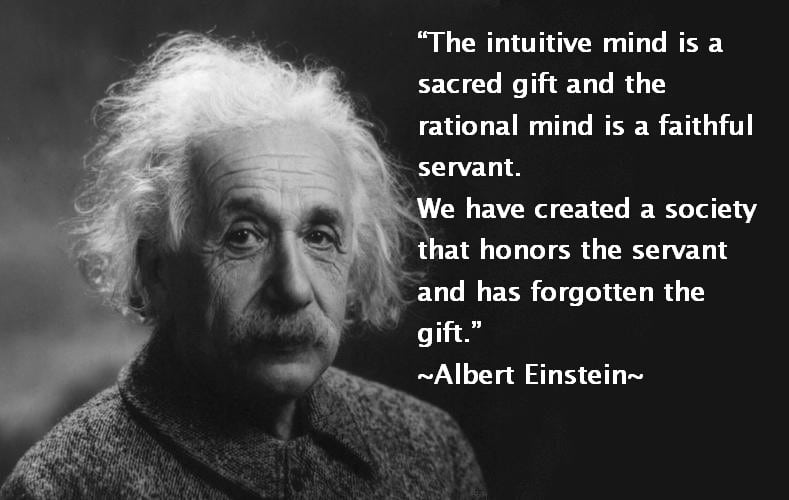
In nursery and primary school our education focusses on our whole bodies – we dance, do drama, and paint with our hands and feet. By secondary school, we're only being educated from the waist up (with occasional classes of PE), and by university we're focussed solely on head-learning. We train the mind to gather and process information – facts, figures, critical thinking, logic, reason – and we test these abilities (and these alone) via incessant exams. The people best at this are ones admired and rewarded most highly in our society: scientists, lawyers, doctors (because western medicine is essentially all reductionist), bankers, computer programmers, etc. On the whole our Western society is skewed towards the rational over the emotional. Einstein knew this when he said
“The intuitive mind is a sacred gift and the rational mind is a faithful servant. We have created a society that honours the servant and has forgotten the gift.”
― Albert Einstein 
The problem is the rational mind is not a good leader. It's too cold and calculating. But it is an excellent advisor. When we let the intuition, the true king/leader, assume its rightful place then logic and reason becomes only one source of information among many. By the same account, emotions and feelings are also just another source of information. In the end I decided to take the bus not cycle!

To take another example, back when I was deciding whether or not to quit my job as an astronomer, my rational mind was screaming "Why quit? You're well-paid, an expert at what you do, and have put in years of training." But it could also calculate how difficult it would be to get a job in the UK and what impact that would have on my relationship. This was all excellent advice. I also knew I wasn't enjoying the day-to-day aspects of my job, feeling quite isolated and frustrated with my colleagues, and I wanted to work more with people in an everyday, grounded sense. All of these things informed my eventual decision, which I feel almost bubbled up out of the muddy quagmire of swirling thoughts and opinions.

I guess you would call that my intuition...


I am part of the Zenways sangha led by Zen master Daizan Skinner, and we meet twice a week at our dojo in Camberwell, London. For more info see www.zenways.org


I'd love to hear from you


Any comments or thoughts about your king and advisors, I'd love to hear from you. Leave a comment below, join the discussion. 

Pass it on

Enjoyed this post? Then please tweet it, share it on Facebook or send it to friends via e-mail using the buttons below.

Thursday, 13 November 2014

Intuition and gut feeling

In Zen practice we purposefully cultivate attention in our hara, our belly, our gut. We emphasise turning off our discriminating, thought dominated mind, and develop a kind of knowing that is beyond this’s and that’s, right or wrongs – essentially beyond language itself.

One word in English that we often use to point to this direct knowing is “intuition”. Intuition is defined as an "almost immediate situation understanding” – a kind of direct, immediate knowing. “How do you know that?” someone asks, and you reply “I don’t know, I just do”. This is intuition speaking. Like a hunch or a feeling. You arrive at a conclusion through processes that typically remain mostly unknown to your conscious mind.

The word intuition comes from the Latin intuir, which means ‘knowledge from within.’ In the last few centuries intuition has been kinda poo-pooed because it’s not rational - it's “just a feeling”. With the rise of science in the West, rational thought has rather taken superiority.

Second brain


Recently there’s been quite a bit of discussion about what people call our "2nd brain” down in our gut. This 2nd brain consists of sheaths of neurons embedded in the walls of our gut – intestines, stomach, etc. – about 100 million of them in total. That's more than in either the spinal cord or the peripheral nervous system (but a good deal fewer than in our 1st brain!). The feelings from these gut-nerves influence, to quite a large degree, our emotions, so you could say our second brain very much informs our state of mind. One obvious example is when we feel butterflies in the stomach. The butterflies sensation arises as blood is redirected out of our digestive system as part of our flight or flight response, and it signals to us we’re feeling nervous or anxious. As it says here, a lot of the information that the gut sends to the (head) brain is about well-being, which is understandable since eating and digestion are fraught with danger! Like the skin, the gut must stop potentially dangerous invaders, such as bacteria and viruses, from getting inside the body.

Intuition is a very undervalued and underused skill in most people. But interestingly, people with certain types of brain-damage who can’t form emotional intuitions can take hours to decide between two kinds of cereal! They’re caught trying to reason out whether they want Frosties or Coco Pops, and ultimately it’s not a rational decision (any rational person would choose muesli...).

In research, you’ll often start solving a problem by going with a hunch – it’s what sends you off in one particular avenue of enquiry over all the others you could go with. Einstein knew:
The workings of intuition transcend those of the intellect, and as is well known, innovation is often a triumph of intuition over logic. – Albert Einstein

How does intuition arise?


Obviously intuition doesn’t just arise out of nothing. The more experience you have, the better your intuition. Intuition arises out of a rich array of, what you might call, patterns of experience – memories, understanding, learning, observations, that all become integrated into your being. 
As Massimo Pigliucci explores in his book, "these days cognitive scientists think of intuition as a set of nonconscious cognitive and affective processes; the outcome of these processes is often difficult to articulate and is not based on deliberate thinking". In his famous book "Thinking, Fast and Slow", Nobel Prize winning author Daniel Kahneman notes that "thoughts come to mind in one of two ways: either by “orderly computation,” which involves a series of stages of remembering rules and then applying them, or by perception, an evolutionary function that allows us to predict outcomes based on what we’re perceiving. It is the latter mode that precipitates intuition."

So let's say you're a company executive conducting interviews for a job. You've been at it all morning and none of the candidates have been any good. On paper, the next two candidates have everything and you're excited. The first one interviews very well, comes across confident, gives well thought-out answers, and has great body language. The second one also answers well, is inquisitive, quick, and well-presented.

So who do you choose? From a rational point-of-view, both are equally good, but you just get a feeling that the first one hasn't got what it takes. The feeling arises from your gut (what in Japanese they call the 'hara'), and informs the decision made by your brain.

Intuition in Zen


In Zen, however, we're moving to a place of intuition that's not based on memory, experience, or discrimination. By going beyond just knowing about things to actually perceiving things directly, we come to understand our true nature and in doing so literally become the whole Universe. And if we are the whole Universe, then there's no finding out – we know. We enter the flow of the Universe so fully that the 'knowing' is no longer ours, but an obvious, immediate response of the Universe.

As a teacher, this is a very valuable tool. The more sensitive you are, the more you can enter this flow, and the less our feelings are coloured by our own desires, wishes or judgements, then the more truthfully we can 'intuit' how another is feeling.
Years of training, repetition, beds experience into being,
And from the gut arises direct knowing, a felt sense.
So easily coloured by desires,
Train hard and make discernment clear.

I am part of the Zenways sangha led by Zen master Daizan Skinner, and we meet twice a week at our dojo in Camberwell, London. For more info see www.zenways.org


I'd love to hear from you


If you've read any of the booked I mentioned, or have any other comments about intuition, I'd love to hear from you. Leave a comment below, join the discussion. 

Pass it on

Enjoyed this post? Then please tweet it, share it on Facebook or send it to friends via e-mail using the buttons below.

Thursday, 21 November 2013

Mindsight and the wheel of awareness

How would you describe our ability to perceive our mind and that of others?

Self-awareness? Consciousness? Emotional/social intelligence? Theory of mind? Dr. Dan Siegel of the UCLA School of Medicine and co-director of the Mindful Awareness Research Center came up with the term "mindsight". Nice word! I like it. He wrote a book about it in 2010 called "Mindsight: The New Science of Personal Transformation".

He describes mindsight as "a powerful lens through which we can understand our inner lives with more clarity, integrate the brain, and enhance our relationships with others." He says it's "a kind of focused attention that allows us to see the internal workings of our own minds."

We all learn and develop mindsight as we grow up. Through it we start to see what's inside, to map out the internal landscape of our mind and recognise what things like sadness, anger, grief, pleasure, love, and excitement are. But the skill of mindsight goes way beyond just observing what's inside. Through focussed attention we can learn how to notice and acknowledge a thought/feeling/sensation, without getting caught up in it or identifying ourselves with it. It can give you perspective. In Dan Siegel's words, "it gives you the understanding to distinguish the difference between 'I am sad' and 'I feel sad'." This is similar to what the great Zen Master Obaku said: "that which sees suffering is itself not suffering".

In his talks and books, Dan Seigel likes to use the analogy of a camera lens. As we grow up, he says, if parents don't provide clear feedback on the child's emotions and feelings then the mindsight lens can become distorted. Nurturing and healthy relationships help develop a "stabilised mindsight lens", and (from his book) "when the lens of our mindsight camera is stabilised, the details come into focus. We see with more depth and precision.

Developing our mindsight skills (if you like, stabilising and polishing the mindsight lens) is an important part of what we do on my courses in mindfulness (next course starting 17th Jan 2014), and is also an integral part of my yoga classes.

Along with this idea of mindsight, Dan Seigel has also come up with lovely analogy to help us practise mindsight. He calls it the "Wheel of Awareness" (click here to listen to his recorded meditations).

Close your eyes and picture a bicycle wheel (or just look at this picture...).


In the middle there is the hub. The hub represents knowing or awareness. Around the outside is the rim (perhaps carbon fibre if you're into racing bikes, or perhaps old-fashioned steel that's slippery to your brakes when wet...), and the rim represents all the things that can be known. The spokes represent our attention – the way we become aware of all these things. We can think of sending out a spoke of awareness from the hub to the rim.

In his meditation, Dan Siegel splits up the rim into four quadrants or segments.
  1. The first segment represents our senses. The ways in which we connect to and are aware of the outside world. The ways we take in data about what's around us: sounds, touch, tastes, sights, and smells.
  2. The second segment represents the interior of the body – sensations, feelings, proprioception. Just take a moment to notice all the parts of your body and all the sensations arising from within the body.
  3. The third segment represents mental activities. These include thoughts, experiences, memories, emotions, moods, plans, feelings, desires, wants, etc. This segment also includes our awareness of how things arise and pass. Do these things come up suddenly or gradually? Do they then stay constant, fade in and out, or vibrate? Then how do they leave? And are they replaced immediately with something else or not?
  4. The fourth quadrant represents our sense of connection to others – to people physically close to us, to our family, friends, people in the neighbourhood, the city, country, continent, in the whole world, and finally to all of life.
In the expanded version of his meditation he also directs us to bend a spoke of attention back towards the hub. If you've got carbon fibre spokes this'll be difficult... What he's asking us to do is become aware of our awareness itself. Remember that quote by Master Obaku? "That which sees suffering is itself not suffering".

I'd definitely recommend doing one of the meditations from his webpage - the shortest is only 8 mins long.

Points to anyone who comes up with a way of incorporating the valve and the reflector into this analogy. Add your comments below.