Showing posts with label monk. Show all posts

Thursday, 15 October 2015

Zen pilgrimage walk: The endless end

Earlier this summer I did a 4-week pilgrimage walk through the country as a Zen monk – carrying no money, just living from my alms bowl. So far I've written a number of articles about the walk (including why I would even do such a thing, the pain in my feet, and how I lived from the bowl on people's generosity, and sleeping rough).

The destination for my walk was a hill in the east of Lancashire, near the town of Burnley, called Pendle Hill. 


Pendle Hill as I approached it

Why Pendle Hill?


I am British, born and raised, but I practice on a path that originated in India and has been refined through the centuries in Japan. I took ordination in the Zen tradition and donned the robes of an Unsui (novice) monk. Walking up the country, I was a curious site: white British, but wearing a distinctly Japanese outfit, practising a "foreign" religion.

Pendle Hill is an important place in a home-grown British spiritual tradition – Quakerism. It was the place where it's founder, George Fox, had a great "opening" or revelation back in 1652. He described his vision on the hilltop :
As we travelled, we came near a very great hill, called Pendle Hill, and I was moved of the Lord to go up to the top of it; which I did with difficulty, it was so very steep and high. When I was come to the top, I saw the sea bordering upon Lancashire. From the top of this hill the Lord let me see in what places he had a great people to be gathered.
    — George Fox: An Autobiography, Chapter 6

Quakers


Fox initially just wanted to transform the existing Christian structures in England to a more accurate following of Christ. For this, he and his followers were persecuted by Cromwell's Puritan government and then the "restored" Charles II Catholics. Fox argued, based on the teachings of Peter (Acts 2 & 3), for an egalitarian, spirit-filled Christianity that would not be oppressive of people on account of race, sex, or class. By 1655 a national Quaker organisation had been founded.

Although Quakers have their roots in Christianity, they value the teachings and insights of other faiths and traditions, making them a very egalitarian and accepting group. They strongly believe that faith is lived through action, which is lived out through their social and political engagement to building a more just and peaceful world.

Quaker worship (called 'meeting for worship') normally lasts for an hour. They sit in stillness and quiet, listening and reflecting, looking for a sense of connection with those around, with themselves, and with God. During worship people may feel sufficiently moved to get up and speak, pray or read aloud. This is called "ministry", and can be done by anyone in the meeting. There are no priests, preachers, songs, set prayers or talks, and the table in the middle of the meeting circle often has the Bible, maybe the Qur'an, and a book called "Quaker faith & practice" – a collection of writing and experiences of Quakers from their 350-year history.

Over the years, Quakerism spread out through the world – notably into North America. Pennsylvania was actually established in 1681 by a Quaker. Here in England Cadbury's, Terry's, Fry's, Rowntree, Lloyds Banking Group, Barclays, and Clarks shoes were all set up by Quakers (although I'm not sure all these companies still operate with Quaker morals...)

So not only are the Quakers a British home-grown spiritual organisation, they are also very Zen-like. They practice by sitting in silence, sensing their connection with others and the world, and they put a big emphasis on living their faith (in Zen the phrase is do-zen, meaning "moving/acting Zen").

This made Pendle Hill a very appropriate place to end my own pilgrimage and connect what I was doing back to my own spiritual culture.


The endless end


At about 6pm on Thursday 6th August I got to the top of the hill, accompanied by a dear friend Kim Bennett. It was quite a climb, but totally worth it! They sky was blue with scattered fluffy white clouds, and you could certainly see "the sea bordering upon Lancashire".

It felt wonderful to be up there. Exhilarating!

We sat on the edge of the hill and did 30mins of zazen (sitting meditation) together. I could feel the earth, the history, and the moment vibrating up through me.

Did it feel like the end? No it didn't. I'd spent so many hours and footsteps over the previous weeks focussing on just being in the present moment – allowing the sensations, the experiences, the people to come and go – that this was just another moment. I was here... then I would come down the hill, come back down south, and get on with the rest of my life. It was an endless end. Just another event in the tapestry of life.


Sean's inspiring poem


Somewhere along my journey, another dear friend, Sean Collins, gave me this beautiful poem which I wanted to share with you. My monks name was Kuren.
Kuren
All the practice you have had
When sitting on you Zafu pad
A Buddha balanced on your rear
Aware of what you see or hear
Present with what you love or fear
Who are you?

Draw your sword and slice the bonds
That tie you to, or keep you from
The lessons that await you
Ancestors who create you
Those people who may hate you
Who are you?

Get up,
wake up
and walk to meet
the road that falls beneath your feet
in sun, wind, rain or sleet
Who are you?
Kensho!!!
(Kensho means seeing your own true nature)

All of life is a pilgrimage


Near the end of my walk someone pulled over in their car and offered me a lift. I couldn’t accept, but after talking for a while he said he thought we are all on our own kind of pilgrimage. I think he was right – life is like a long pilgrimage and we're all walking on our own path.


I am a member of the Zenways sangha led by Zen master Daizan Roshi, and I teach meditation, mindfulness and yoga at the ZenYoga studio in Camberwell, London. See my website for further details.

I'd love to hear from you

Do you feel like you're on your own pilgrimage of life? Leave a comment below, I'd love to hear your thoughts.

Pass it on

Enjoyed this post? Then please tweet it, share it on Facebook or send it to friends via e-mail using the buttons below.

Thursday, 8 October 2015

Zen pilgrimage walk: Sleeping rough

Earlier this summer I did a 4-week pilgrimage walk through the country as a Zen monk – carrying no money, just living from my alms bowl. So far I've written a number of articles about the walk (including why I would even do such a thing, the pain in my feet, and how I lived from the bowl on people's generosity).

In this post I'd like to share a little bit about the nights when I didn't have anywhere planned to stay.

The route for my journey was organised around people and places I wanted to visit. But I didn't have a bed lined up for every night. The other nights I had to have to find shelter for myself.

I've done some wild camping in my time, both here and abroad – but that was always with a tent. On this trip I took only a sleeping bag and a roll mat so on those nights I didn't have a bed, I had to find somewhere under-cover to protect myself from the elements.

The first rough night

The Post Office sorting office in Fordingbridge

The first night I slept rough, I ended up in a lovely small town called Fordingbridge in Hampshire. That evening I limped into town with my feet hurting to such a degree that I couldn't spend ages searching around for a place. After a short recce up the high street I spotted a covered porch outside the post office building. Actually it was a sorting office and parcel collection place, and the front of the building had a ramp up to the porch with a door in the corner that looked very unused. There were cobwebs all over it. It was ideal – a good roof, mostly hidden from the road, and not too dirty.

As I unrolled my mat and sleeping bag, I took note that the office opened at 6am, so I set my alarm for 5:15 to make sure I was up and out of there – just in case.

The town quietened down by about 9:30-10pm, with only the occasional car carrying it's driver up to the chippie round the corner. It was strange to hear the road so loudly as I was dropping off, and I think I remained quite vigilant to being noticed for quite some time. Eventually I fell asleep.

I woke up with the alarm. Just as I was rolling up my mat at about 5:45 the door in the porch started to unlock. Shit... I was convinced they're going to shoo me away and report me to the police! But so what if they did? – that would just be part to the pilgrimage. But I didn't think like that at the time.

So the door opened and out leaned a postie. "Do you want a cup of tea?" he asked. I was blown away! "That'll get you warmed up for the day!" he continued. Wow! So I sat there drinking my tea in a warm glow of incredulity and gratefulness to the kind postman.

That's how it continued really! I slept in someone's garage, under some scaffold, in the awning of a disused cafe, in a church doorway. I never had any major problems finding shelter.

The night of the Waitrose bridge


One evening I was walking into Newbury. On these days where I knew I didn't know where didn't know where I was going to sleep, the anxieties usually started arising at about 3-4pm when I still had a few hours walking to go. First would come the (re-)realisation that I didn't know where I was going to sleep that night. Then would come the thoughts – could I sleep in that bus stop if I had to? What if I was in deep suburbia and there was nothing but rows of houses? Where would I find then? That place looks good, but I can't stop now, it's too early. What if I can't find anywhere? Etc, etc.

Walking into Newbury I remember checking out some hedgerows, and some emergency stairs at the back of an office block. Them, as I was walking past a brand new Waitrose I noticed they had a delivery entrance on the other side of a short bridge. I surreptitiously snuck through some undergrowth to have a look under the bridge and happily found a nice bit of fairly clean, flat concrete between two pillars. I unrolled my mat as you can see in the photo.

A while later as I was in my sleeping bag, just nodding off, a couple of homeless people brushed past. I pulled up my head and the lady said "alright mate, we won't be long." They went round the corner and proceeded to have a blazing argument with lots of effing and blinding. This was the only time on the walk where I really felt vulnerable. Should I leave? It would take me at least 15mins to get dressed and pack up my stuff, and it would be very obvious to them what I was doing. I decided to just keep my head down. To them I was probably just another homeless guy – why should they bother me? And they said they wouldn't be long...

The argument continued for some time – but they did leave eventually. It was a strange feeling to drop off to sleep in that situation. I kept telling myself to relax, and whatever was going to happen would happen. Trust in the universe! I had an alright nights sleep in the end. The canal my route was
following was only 30secs walk away and it was a beautiful morning.


The night of the Church Doorway


Later on in the walk, I was looking for a place to kip in Balsover, Derbyshire. After some time looking around the edges of the town, I spotted a church doorway. I'd often stopped in church porches for breaks or to shelter from the rain, so when I saw this doorway I felt compelled to investigate!

As I approached, an older couple came out of an adjacent doorway of the church. I had to explain myself: "I'm a Zen monk... Would you be ok if I slept in this doorway?" They weren't exactly encouraging, but said it would be fine – as long as I didn't do any graffiti or get caught by the police.


What I learned


Before this walk I'd never slept rough. Granted when I was on my walk it was summer, and the nights weren't too cold, but I found it a surprisingly comfortable and very liberating experience. By the end of the walk I had quite a good eye for spots to shelter in – both in the town and out. My absolute ideal place to sleep would've been a barn full of hay. I actually found one once, but sadly it was the middle of the day at the time. Only once did I feel slightly vulnerable, but that was just my anxiety towards strangers. I should've just got up and had a chat to them.


I am a member of the Zenways sangha led by Zen master Daizan Roshi, and I teach meditation, mindfulness and yoga at the ZenYoga studio in Camberwell, London. See my website for further details.

I'd love to hear from you

Ever had a similar experience? Leave a comment below, I'd love to hear your thoughts.

Pass it on

Enjoyed this post? Then please tweet it, share it on Facebook or send it to friends via e-mail using the buttons below.

Thursday, 10 September 2015

Zen pilgrimage walk: Wisdom of the robes

I recently got back from a 4-week pilgrimage walk through the country, which I did as a Zen monk – carrying no money, just living from my alms bowl. In the first article in this series I talked about why I would even do such a thing, then I discussed the pain in my feet and how I dealt with it. Last week I talked about living from the bowl and the wonderful generosity I found along the way.

This week I want to focus on what I was wearing and the wisdom I found within it. Will you stay with me? (couldn't resist the alliteration!)

No, I don't mean Daizan had tucked a booklet of Zen wisdom into the folds of the robe for me to find (sadly!) – I mean the wisdom embedded in the design and material of the outfit.

The robes


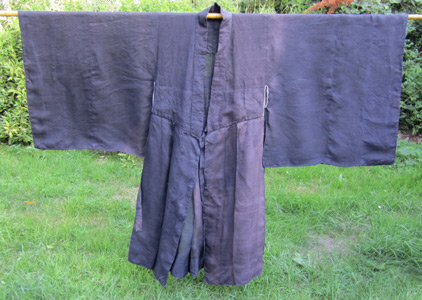
If you had to wear one set of garments for travelling on the road, and you weren't going to add or take away any layers, then the monk's robes I had weren't far off the ideal. There are three layers: the undergarment is called a jubon and is equivalent to a shirt. It's waist-length and folds over the body in the traditional Japanese way. The second layer is called a kimono and mine was grey (can also be white). This, again, folds over in the same way, but is full-length down to my ankles. These two inner layers, folded around the body, are held together with a wide, elasticated belt called an obi. The third layer is the outer koromo, made of a kind of denim material (indigo hemp I think) that comes down to about mid-calf level, has large sleeves, and has ties at either side at the waist to fasten it.

Traditional Rinzai Zen monk's travelling clothing

Another belt called a shukin is wound around the waist to hold everything together (more on that below). The lower part of the robes could be hitched up underneath the shukin (on warm days or to make walking easier), and the long sleeves could also be tied up at the shoulders (again for warm days).

Robes with the sleeves tied up, showing the shukin belt with the rakusu tucked behind it.


Shukin


The skukin (meaning "hand cloth" in Japanese) is a very interesting part of the robes (the Soto school has a similar rope belt called a shiken). I haven't been able to find out much about its origin, or why it's tied in such a way (some info here if you want to dig). At first it seemed an unnecessary weight and a bit of a hassle, but as time went on I began to see the deep wisdom embedded in it.

After a few days of walking I noticed that I wasn't feeling that hungry during the day. It was only when I stopped for the night and undid my robes that I started feeling hunger pangs.

Influenced by the monastic culture at the time, the Buddha only ate breakfast and lunch, and in fact made a rule that his monks shouldn't eat after midday. Monks in the Buddha's day also didn't work or cultivate the land, relying only on alms food. As Buddhism spread north into China, the Chinese weren't so happy with supplying the monks with 100% of their food, so they began farming the land around the monasteries. The colder climate and the extra work meant monks had to eat more (and wear more). To begin with, they kept with the 'no eating after midday' rule, and in the evenings the monastery kitchens gave out hot rocks that the monks would put on their stomachs to assuage their hunger. As Zen spread into Japan, they relaxed the after-midday rule, and the (still unofficial) evening meal became known as yaku seki (meaning "medicine stone").

So the pressure and warmth of the shukin belt against my belly as I was walking must have been doing the same job of stopping any hunger pangs.

The other effect I noticed was that it really helped bring my attention to my hara. In a way it felt like a weight-lifters belt, but swivelled around 180deg. It held everything in, and gave my abdomen something to breathe against. I could feel the swell of my breath against the shukin in the front of my belly, in my sides, and in my lower back, and this really helped me in continually relaxing my belly with each breath (see my article on pain). By resting my attention in my hara (and tanden particularly), I could also build my energy there, helping my feel more grounded and stable.

Hat


The hat (kasa or ajiro-gasa in Japanese) I had is of the traditional conical type found all over East Asia. It's made of woven bamboo and coated in the traditional way to make it waterproof – by using Persimmon juice (not by me I hasten to add). I found it a very effective umbrella in the rain, and a great sun hat on sunny days. The only problem was that it wobbled and often slipped forwards over my face with just a breath of breeze! Without the shoe-lace chin strap, the hat would for sure be lost in a hedge or ditch by now.
Me in the rain cape (in the Yorkshire rain -
looking surprisingly chipper)


Rain


I had "the official" Rinzai rain cape with me on my journey, which was big enough to cover pretty much everything including my rucksack – see photo. The only thing that got wet were my feet, and on rainy days these really got very squelchy...


Rakusu


The rakusu is worn around the neck and hangs, a bit like a bib, over the chest. It is a miniaturisation of the traditional kesa (or outer robe, originally worn by the Buddha). The story goes that the Buddha was out walking one day with his assistant Ananda. As they crested the top of a hill and looked down on the patchwork of rice paddies in the valley below, the Buddha said to Ananda, that's how I want our robes to be – a patchwork of cloth cut into a square. This pattern symbolises the "all is different" aspect of reality, together with the "all is one" aspect, and is maintained in the design of the rakusu. The white disk on the left strap is a left-over from the clasp that fastens the large kesa around the body.

I was given my rakusu when I first took the precepts as a lay person back in 2011. On the back is a white patch which has my first (lay) Dharma name (Kakushin) calligraphed onto it by Shinzan Roshi.


Footwear


I discussed my footwear in this previous article. Of everything that happened on the walk, the pain from the footwear taught me the most. For this I am extremely grateful.


I am a member of the Zenways sangha led by Zen master Daizan Roshi, and I teach meditation, mindfulness and yoga at the ZenYoga studio in Camberwell, London. See my website for further details.

I'd love to hear from you

Ever had a similar experience? Leave a comment below, I'd love to hear your thoughts.

Pass it on

Enjoyed this post? Then please tweet it, share it on Facebook or send it to friends via e-mail using the buttons below.

Friday, 4 September 2015

Zen pilgrimage walk: Generosity and living from the bowl

I recently got back from a 4-week pilgrimage walk through the country, which I did as a Zen monk – carrying no money, just living from my alms bowl. In the first article in this series I talked about why I would even do such a thing, and last week I discussed the pain in my feet and how I dealt with it.

This week I'd like to talk about one of the most beautiful aspects of the experience – how I lived from the bowl and some of the incredibly generous people that filled it along the way.

Bournemouth


On day two I found myself in the centre of Bournemouth in the town square, just at the end of the gardens leading up from the beach and pier. I'd been walking along the sea front in beautiful sunshine and the whole place was buzzing with people eating ice creams. I'd been given enough food when I left for my first day of walking, so now I needed to gather some food for the onward journey. I'd headed towards what I thought was the busiest shopping area to stand with my bowl for the first time.

Bournemouth square
I sat down on a wall at the edge of the square trying to assess where the best place to stand might be – at the edge or right in the middle? – in front of the cafe or a little away from it? Once I'd selected a spot I thought "right, let's do this," but my body didn't move. "Ok, really, let's get on with it..." – still no movement. What was the resistance? I dropped my attention into my body and realised that I was essentially worried what people might think of me.

That whole day I'd been walking along with my robes flapping in the sea breeze and my big hat shielding me from the sun, thinking "aren't I special, look at me, I'm a monk, bet you've not seen anything like this before...!" Although this egotistic self-importance did dissipate (mostly) in the weeks following, that day it had been quite prominent, and it made for a big contrast between that and having to stand there because I was in need of charity. I was worried because I was putting myself in a place of vulnerability, indicating that I had nothing and needed help.

But really, who was I to ask for help...? I hadn't really got nothing – surely, I had a bank account with money in it and a flat back in London... Well, actually, for this walk I didn't. I'd handed my wallet over when I'd become a monk, and for this journey I had only the robes I was standing up in and a few other bits in the rucksack. If I didn't get any food from holding my bowl I would go hungry. It was as simple as that, and the reality took some time to sink in.

So I got up and walked into the middle of the square, adjusted my hat and held out my bowl.

Of course nothing happened for the first 10 mins. Just lots of legs walking past!

Alms round


As a Buddhist monk you're not supposed to ask for food, or even really make eye contact with anyone when you're on your alms round. Traditionally monks might walk together in a long line from place to place, shop to shop, or known donor to donor, collecting offerings in their bowl. In Zen, the alms round is called takuhatsu (taku meaning 'holding up' or 'requesting', and hatsu meaning 'bowl' – read this lovely article about it here). Obviously, on my pilgrimage I was by myself, and since this isn't a Buddhist country I found standing still in a busy place with lots of footfall worked the best. After I'd selected a suitable spot, I would stand there quietly, simply making the gesture of holding the (empty) bowl in front of me. My hat came down far enough so that all I could see were people's legs (and a few curious kids), and by obscuring my face it anonymises the giver and the receiver – I couldn't see who was coming to offer something until they came very close.

The alms bowl
After some time someone might put some money in the bowl. Some people even thought I was one of those standing statues!! Since I wasn't allowed to accept (or even handle) money, I would say "thank you, but I'm afraid I can't accept money". As you might imagine, most people were a little taken aback by this and asked what I was doing then holding a bowl! I would say something like "I'm on a pilgrimage walk and I'm just collecting a bit of food for my journey, so if you'd like to offer food I would be very appreciative". Since we live in a society where the giving and receiving of alms is not really understood, I had to try and explain what I was doing whilst doing my best not to "ask".

Some people might then take their money and just walk off, some might say sorry that they didn't have any food, but a few took their money and came back a few minutes later with something. Every time that happened it blew me away.

On that first day in Bournemouth a chap came up to me and put some money in the bowl. He looked South American – I can remember is face distinctly. After I told him I couldn't take money he said "ok, give me 10 mins". He then came back with a shopping bag of food, including sushi, some crisps and water, and then just walked off. He didn't ask me what I was doing or why – nothing. It was beautiful, and I remember standing there in tears. He just gave.

Variety


Many people have asked what kind of food I was given. Over the weeks I received all sorts of things. One that first day in Bournemouth I got a McDonalds cheeseburger! Standing close to a Greggs one morning someone gave me 4 hot sausage rolls; standing near to Waitrose I got prepared salads, quiches and gingerbread biscuits. One very kind policewoman in Loughborough offered me her snack of Halva prepared by her cousin that day. Standing near a Tesco Metro I got good old British white-bread sandwiches. One time a lovely little 6-year old (and her dad) gave me 10 apples!

Only one day did I struggle to get enough to eat after standing for more than 2 hours. The rest of the time I found people to be incredibly generous; and thoughtful – that chap in Bournemouth wasn't the only person to get me sushi (nice Japanese connection!).
Something similar to what I would've looked like


Occasionally (less often that I would've predicted) someone would strike up a conversation about Zen. One chap in Huddersfield said he'd walked past me holding my bowl while he was on the phone to his mum, and just had to come back and ask me what I was doing – he said he felt something different about me and was intrigued. We talked about his attempts to meditate while at university and how he wanted to get into it more (and off the weed). On another occasion a young guy came up and, after introducing himself as being part of a Christian group, started asking me what I believe in and how I practice. He left insisting that I take a pamphlet on the wisdom of the Gospels.

Living out of the bowl


Living from the bowl was one of the most humbling experiences I've ever had. I was entirely dependent on the generosity of strangers, and had to eat just whatever they gave me. But I never once went hungry, and even had a fairly balanced diet.

Peoples' generosity blew me away and it left me thinking, would I be so generous if the situation were reversed?


I am a member of the Zenways sangha led by Zen master Daizan Roshi, and I teach meditation, mindfulness and yoga at the ZenYoga studio in Camberwell, London. See my website for further details.

I'd love to hear from you

Ever had a similar experience? Leave a comment below, I'd love to hear your thoughts on meditating on pain.

Pass it on

Enjoyed this post? Then please tweet it, share it on Facebook or send it to friends via e-mail using the buttons below.

Thursday, 27 August 2015

Zen pilgrimage walk: Meditation on pain

I recently got back from a 4-week pilgrimage walk through the country, which I did as a Zen monk – carrying no money, just living from my alms bowl. In last week's article I talked about why I would even do such a thing. This week I'd like to talk a little about one of the most intense aspects of the walk - the pain in my feet.

Before I get onto that though, I should say a few words about the route I took and my unusual footwear.

The route


My meandering path was defined by the people I wanted to visit along the way: there was the Dorset contingent of our sangha based in Bournemouth, my partner's mum who lives in Salisbury, some other sangha members in Whitchurch near Andover and in Oxford, the Amara Vati monastery near Hemel Hempstead, the Nipponzan Myohoji temple at the peace pagoda in Milton Keynes, another sangha member in Northampton, the Tariki Trust house in Leicester, and some another sangha members in Nottingham, Sheffield, and Hebden Bridge.

The total distance was about 380 miles (see the full map here).


Footwear


The traditional footwear for a Zen monk on the road would have been a pair of white socks with a separated big toe, called tabi, worn together with a pair of straw sandals, called waraji, which are held on with laces around your ankle and lower-leg. In more modern times, a rubber sole has been added to the tabi socks to make them more robust and more like canvas boots (called jika-tabi). The sole is very thin and flexible (similar to bare-foot running shoes), so the waraji add a nice layer of padding underneath.

Under normal circumstances, the waraji wear out after about 3 days of walking, so I knew I was going to need a good stock of them for the whole journey. I got 10 pairs kindly brought over from Japan.

But while I was on our Zen sesshin retreat, a friend gave me a big rubber sheet, together with some glue and a needle and thread, and showed me how to sew a rubber sole onto the bottom of the waraji sandals. We had enough to rubberise two pairs, which in the end was actually all I needed. The rubber bore the brunt of the tarmac abrasion and the second pair fell apart literally on the last day of my walk! Thanks so much to Gensho for showing me this technique. I now have 8 spare pairs of waraji for sale...

Since the jika-tabi are essentially the socks and fit very snugly, I wore nothing inside them. This was to the consternation of all my acquaintances who had ever done any hiking...

Developing sensations


I'd had a couple of longer practice-walks in the tabi boots and waraji before I started the pilgrimage. After each of these I carefully noted where the blisters had begun to develop. People had recommended zinc-oxide plaster tape (easily available at Boots) as a way of avoiding blisters, so on day 1 I taped up my feet in all the places I knew blisters were likely, and happily walked off into the Dorset countryside.

Little did I know that zinc-oxide tape is no match for the tabi boots... Over the first few days of walking I developed some fairly substantial blisters (under the tape), accompanied by some fairly substantial pain. In Salisbury, my partner's mum very kindly did some internet research and bought me some adhesive cotton padding to put on my feet. One of her friends also extremely kindly donated me a few packets of Compeed (blister plasters) which were very helpful.

I hadn't at all anticipated the level of pain I experienced in my feet over that first week. Every step became excruciating, often to the point of tears... The strongest sensations came when I started off again after a break (I'm going to guess here that after walking for some time, the reason I feel less sensation is that the pain gates in my nervous system began to close – see my blog article about pain gates here).

An important turning point in those first few days was when I realised that I was doing no long-term damage by continuing to walk on the blisters. Knowing that the pain wasn't carrying any serious messages, I knew that it was simply a sensation and I just had to get on with it.

[Health warning: Most of the time pain is a very important signal saying that damage to the body is occurring and something needs to be done about it! If, for example, you've got your finger in the gas flame, just allowing and accepting the sensations isn't going to do you much good.]

Wanting the pain to stop


I quickly realised that tensing up against the pain made things worse. Wanting it to go away also just made things worse. Wanting (or 'craving' in Buddhist terminology) stems from the wish for things to be different to what they are right now. And of course, in this moment, right now, how can things be different? Maybe in a future moment things will be different, but right now it's utterly futile to want things to be anything but what they are. This wanting (whether that's in the sense of pulling towards or pushing away) is what causes suffering – not accepting that things are as they are right now.

I wrote this on day 6:
"Walking is very simple - just put one foot in front of the other. After 6 days of it though, the pain is intense and the mind constantly seeks ways to escape, for relief. There is no escape though - only through softening and acceptance does the suffering end, and a constant re-realisation that there is only now."
So my walking became a practice of softening my feet, every step – softening and allowing the sensations. Not trying to make them go away or make them change in any way. In that first week, after feeling quite nauseous at the end of a few of the days, and I realised I'd also been tightening my belly against the pain. So my walking became a practice of softening my feet and my belly, every step, every breath. I found my footsteps and breath often came into sync (two steps in, three steps out), and on each out-breath I concentrated on totally relaxing my belly (or hara). This helped a lot.

Later I realised that in my softening there was still a whiff of wanting – because I wanted to make the pain feel less. Fair enough you might say – but this was still a craving for something other than the reality of that moment. It was subtle and much more difficult to let go of.

So like this – focussing on relaxing my feet and belly, and letting go as much as I could of the wish for the pain to go away – the miles fell away. There was the rhythm of the breath, and the rhythm of the walking – step after step. Not wanting anything to be any different – enjoying the sunshine on my back and the smell of the hedgerow flowers as they wafted by, and simply allowing the pain sensations to be there (whether they were strong, sharp, dull, or throbbing).

Audio diary entry from 5th August where I talk about the pain in my feet:


Night time


After some weeks of walking the blisters all but cleared up. But you know that feeling of ache you get in your feet after standing up for a long time? – that took over! And you know the feeling of relief you get when you do finally sit (or lie) down? – kind of like a feeling of expansion? – that became the dominant feeling during the night. It was like a feeling of relief that became so intense that it was painful in of itself!

But I kept on reminding myself of this famous adage which couldn't be more true:

"Pain is inevitable, suffering is optional" - Buddhist proverb

By the morning though, my feet always felt ready to face another day of walking. It's amazing what a night's sleep can heal.


I am a member of the Zenways sangha led by Zen master Daizan Roshi, and I teach meditation, mindfulness and yoga at the ZenYoga studio in Camberwell, London. See my website for further details.

I'd love to hear from you

Ever had a similar experience? Leave a comment below, I'd love to hear your thoughts on meditating on pain.

Pass it on

Enjoyed this post? Then please tweet it, share it on Facebook or send it to friends via e-mail using the buttons below.

Thursday, 20 August 2015

Zen pilgrimage walk: What’s it all about and why I did it

"When you said you'd been on a walking holiday, this isn't quite what I had in mind..."

I’ve just got back from a 4-week pilgrimage walk through the country, which I did as a Zen monk – carrying no money, just living from my alms bowl. In the next few weeks I’m going to publish a series of articles on different aspects of the walk. This week I’m going to approach the question
that quite a few people have asked me: “why would you do such a thing…?!"

Good question!

Why would I do such a thing


I’ve been practising Zen now for close to 8 years – all of it under the guidance of Zen master Daizan Roshi. About 6 months ago Daizan asked me if I would be interested to do a pilgrimage walk (similar to the walk he did when he first got back from Japan 8 years ago). As we discussed it, there seemed to be two main reasons for asking me: firstly it would be a way to continue and deepen my own personal practice, but also it would provide some opportunities for me to practise teaching. For a few years now I’ve been part of Daizan's Junior Zen teacher training programme, but it’s difficult to find many opportunities to teach since I attend and practice at the same dojo as Daizan and everyone comes to see him (as it should be). Getting out and about, away from Daizan's large and wise shadow, I would be able to flap my tiny little Zen teachers wings... I would be putting myself in the situation of having to explain myself – "why are you doing this walk?", "why are you dressed so funny?", etc.

Daizan gave me the option of doing the walk as a monk or lay person, and with or without money – it was my choice. After a week or so pondering this, I decided that if I was going to do this I should do it properly, in the traditional way: ordain as a monk and do it without any money.

Ordination


Ordination ceremony

So on 12th July, the last day of our 5-day Zen retreat down at Gaunts House in Dorset, I ordained as a Rinzai Zen monk in the Inzan lineage under Shinzan Roshi and Daizan Roshi. The ceremony lasted about 30mins and included a certain number of precepts that I was expected to live my life by: 

The 10 Bodhisattva Precepts (given to all lay people)
  • Do not take life
  • Do not steal
  • Do not indulge in abusive or inappropriate sexuality
  • Do not lie
  • Do not abuse intoxicants
  • Do not criticise others
  • Do not boast of your attainments and belittle others
  • Do not be mean in giving Dharma (teaching) or wealth
  • Do not harbour anger
  • Do not defame the three treasures (do not deny the Buddha within yourself or in others)
Together with one modification and 5 more precepts for a novice-monk
  • Do not engage in any sexual activity
  • Do not eat after midday (except whilst travelling)
  • Do not sing, dance, play music or engage in any kind of frivolous entertainment
  • Do not wear jewellery, perfume, or make-up
  • Do not sit on high chairs or sleep on luxurious beds
  • Do not handle or accept money

Because it wouldn't be possible for me to continue keeping these precepts when I got back to life after the walk (I would have to go back to earning money, and I'm getting married soon so abstaining from all sexual activity doesn't seem like it would be very conducive to a good marriage...!), my monk-hood was always going to be a temporary one. Unlike in the Christian tradition where monks and nuns typically ordain for life, it's very common in the Buddhist tradition to become a monk for a period then go back to lay life. In many Buddhist countries, young people (mostly men) are pretty much all expected to do a stint in the monastery – typically 1-3 years. I was going to do about 4 weeks.

After I'd taken on these precepts ("will you take this precept?" "YES" to each one), I was given the koromo (robe), the shukin (belt) and the kesa (ceremonial outer robe) to put on, and the hatsu (alms bowl). There was also the ceremonial shaving of the last of my hair (I'd had my head shaved before the ceremony, leaving what's known as the 'Buddha curl' – just a tiny patch over your crown) with the usual homage to the Buddha, the Dharma and the Sangha.

Me just after I'd become a monk, with Shinzan Roshi and Daizan Roshi

After the ceremony, Shinzan Roshi (who was leading the retreat we'd just been on) was adamant that no matter what you did in your life – how many stupas you built, or good deeds you performed – becoming a monk was of the highest merit.

I'll take that...

After the merriment and then lunch that followed the end of the ceremony and the end of the formal retreat, people gradually went home, leaving me to stay the night at Gaunts House by myself preparing to leave the following morning. I had no money at this point, so slept on the floor in the Gaunts House library, and ate some kindly donated left-overs in the fridge for dinner. That evening was full of a whole mix of emotion, with tears and excitement all swirling around together.

I was a monk. I couldn't quite believe it! What did that mean? My partner, Jo, Daizan and everyone else had left – and now I was by myself. It was up to me to actually do this walk. What if I couldn't do it? What if, what if...

Next week I'll write about the walk itself and some of the challenges that the footwear gave me.


I am a member of the Zenways sangha led by Zen master Daizan Roshi, and I teach meditation, mindfulness and yoga at the ZenYoga studio in Camberwell, London. See my website for further details.

I'd love to hear from you

Leave a comment below, join the discussion.

Pass it on

Enjoyed this post? Then please tweet it, share it on Facebook or send it to friends via e-mail using the buttons below.