Thursday, 15 January 2015

The applications of mindfulness in modern society

As I discussed last week modern-day secular mindfulness grew out from its Buddhist origins in the latter part of the 20th Century as people started to realise it's benefit for helping people deal with chronic illness. People like Jon Kabat-Zinn at the University of Massachusetts came up with the, now very popular, 8-week course format for teaching the fundamentals of mindfulness and getting a formal practice embedded in people's daily routine. The results from the early studies were remarkable, paving the way for mindfulness to enter into mainstream society.

Evolving from a clinical to non-clinical setting


Nowadays the two most popular 8-week courses are the Mindfulness-Based Stress Reduction (MBSR) course created by Jon Kabat-Zinn in the US, and the Mindfulness-Based Cognitive Therapy (MBCT) course put together by Segal, Williams & Teasdale here in the UK. Both of these courses, however, originated in a clinical setting as an intervention to treat people with long-term, chronic illnesses (stress and pain in the case of the MBSR, and depression for MBCT).

Part of the popular success of these programmes has been the way they've extracted a practice originally devised for religious purposes within the Buddhist tradition, and applied it in a completely secular way. "Mindfulness" itself is a commonly understandable term with no religious connotations, and the courses themselves are couched in language that is entirely secular and backed up by scientific research.

However, that same scientific research has also shown that daily meditation has the potential of boosting peoples' general health and longevity, increasing creativity, reducing general levels of stress, and a whole host of other benefits. This has long been known in Buddhism! The Zen tradition has a word for this kind of meditation – "Bompu Zen", literally meaning ordinary Zen or ordinary meditation. This is practice with the view or the intention of problem solving.

Mindfulness for wellbeing (and productivity, performance & sex)


An increasing number of people are realising that mindfulness and meditation can have a dramatic effect on their sense of wellbeing, productivity, effectiveness, and happiness – even without a chronic illness to deal with. If you like, the chronic illness has become the stresses and strains of daily life here in our frantic, go-go-go culture!

For example, I teach an 8-week course in Camberwell (South London) that was put together by Zen master Daizan Skinner (Zenways) that is specifically designed to help everyday people deal with their everyday issues. All of us experience stress and pain at some points in our life, so having the tools to help us deal with them as and when they arise can be enormously life-changing. Furthermore we could all do with a way of improving our concentration and focus skills, and that's precisely what mindfulness teaches you. With a few weeks of regular practice I've witnessed just how much of a boost in vitality, energy, and liveliness it gives people!


It's not just individuals who are looking to reap the benefits of mindfulness. As I mentioned last week it's now being very successfully taught in schools (via the Mindfulness in Schools Project) to teenagers and younger ones. Big companies such as Google, Microsoft, BAE Systems and Deutsche Bank are also aware of the benefits of meditation and encouraging its practice at work. In sports, athletes are waking up to the benefits of mindfulness practice on their ability to focus and cope with performance stress first alluded to in the famous book "Zen and the Art of Archery". Etienne Stott (London 2012 Olympic gold medallist in canoeing) said
The famous book from the 1930s
"using mindfulness helped me to win gold. It helped me achieve a level of mental clarity that is vital in intense situations. I would highly recommend mindfulness to any individual or organization who wants to get an edge." 
Multi-time beach volleyball Olympic gold medallists Kerri Walsh-Jennings and Misty May-Treanor swear by it. Basketball coach Phil Jackson famously used it for many years with the Chicago Bulls and the Los Angeles Lakers. Tennis star Novak Djokovic also practices mindfulness. I've also been teaching mindfulness to the GB long-range rifle team over the last year.

Meditation and sex might not be the two things you’d most naturally associate, but as this lovely article from Headspace explains, mindful awareness can help you develop and maintain intimacy and set alight that spark of passion.

Moving beyond mindfulness


Mindfulness practice involves both formal and informal meditation practices, and non-meditation-based exercises. Formal meditation is done in stillness (standing or sitting) with the attention on the body, breath or sensations, or just whatever arises in each moment. There are also formal mindfulness exercises like mindful walking or mindful eating. Informal mindfulness is the application of mindful attention in everyday life – being mindful in all moments.

It's this every-moment awareness is really the end goal. In Zen they have a lovely term for this: Mu-Nen. Nen is the Japanese for mindfulness, and mu is a negative (like "un" in English) - so it translates as no-mindfulness or perhaps effortless mindfulness. It's when non-judgemental awareness is no longer a skill you have to apply, it's just part of your way of being.

When you combine this open-minded awareness with a gentle sense of enquiry, it doesn't take long before certain ideas or insights into your self or the nature of being coming up. It's inevitable. Often this is something that clinical-based mindfulness teachers don't talk about. But it's incredibly important, and can lead to a new way of seeing – a whole perspective shift. That's why I also teach a separate 8-week course based around developing insight and self-understanding.


I am a member of the Zenways sangha led by Zen master Daizan Roshi, and I teach meditation, mindfulness and yoga at the ZenYoga studio in Camberwell, London. See my website for further details.

I'd love to hear from you

What's your experience of mindfulness in modern society? Leave a comment below, join the discussion.

Pass it on

Enjoyed this post? Then please tweet it, share it on Facebook or send it to friends via e-mail using the buttons below.

Friday, 9 January 2015

The origins of modern-day secular mindfulness

Origins of mindfulness


Mindfulness as a word first entered the English lexicon as "myndfulness" in 1530 (John Palsgrave translating the French pensée), as "mindfulnesse" in 1561, and finally as "mindfulness" in 1817. The first use of the word from a Buddhist perspective was in 1921 when Thomas Rhys Davids (then Prof of Comparative Religion at Manchester University) used the word to translate the ancient Indian-Pali word "sati". Before this "sati" was translated as meaning recollection, recall, or remembrance.

Sati is an essential element of Buddhism. It appears in the Buddha's noble eightfold path as the seventh element ("correct" or "right" mindfulness), and is part of the practices of ānāpānasati, satipaṭṭhāna and vipassana. Anāpānasati means mindfulness of breathing ("ānāpāna" is a Sanskrit word relating to inhalation and exhalation). (See here for a simple Zen mindfulness of breath meditation spoken in most of the world's main languages). Satipaṭṭhāna is the practice of applying mindfulness in everyday life, maintaining as much as possible a calm awareness of our body, feelings, mind state. This practice is emphasised in Buddhist practice in order to cultivate an understanding of the constantly changing nature of all things. The word vipassanā means insight into the true nature of reality, but Vipassana as a style of meditation (emphasising the practice of ānāpānasati) was popularised in the West in the 20th Century by Burmese meditation masters Mahasi Sayadaw and S. N. Goenka.

Zen Buddhism also began to find its way into the West in the 20th Century through the writings of D.T. Suzuki and his teacher Soyen Shaku (who spoke at the now infamous 1893 World Parliament of Religions in Chicago). Zen practice contains a strong thread of mindfulness, famously emphasised by Vietnamese Zen master Thich Nhat Hanh. Anāpānasati (or susokukan in Japanese) is also one of the first meditation practices you will be given when you start out in Zen.
"In mindfulness one is not only restful and happy, but alert and awake. Meditation is not evasion; it is a serene encounter with reality."
–  Thich Nhat Hanh in "The Miracle of Mindfulness"
Sitting by lake Walden
As a reaction to the "predominantly reductionist and materialistic" culture that began to dominate the West in the 19th Century, Henry Thoreau wrote his famous book Walden – a reflection on simple living in the natural surroundings of the American north-east near Boston. Jon Kabat-Zinn suggests that, in many ways, the ideas discussed by Thoreau could really be seen as a predecessor to the current interest in mindfulness.


Mindfulness moves into the clinical setting


In 1979, Jon Kabat-Zinn founded the Mindfulness-Based Stress Reduction (MBSR) programme at the University of Massachusetts, heralding the first move of mindfulness into the clinical setting.

Jon Kabat-Zinn got his PhD in molecular biology in 1971 from MIT, and was first introduced to meditation by Zen teacher Philip Kapleau Roshi (author of the "Three Pillars of Zen"). He went on to study at the Insight Meditation Society in Barre, Massachusetts, founded in 1975 by Vipassana teachers Sharon Salzberg, Jack Kornfield, and Joseph Goldstein.

His genius was to realise that the Buddhist practice of mindfulness could be adapted and applied in the secular world to help chronically ill patients cope with stress and pain. His initial programme sparked the now enormously successful application of mindfulness ideas and practices all across the clinical (and non-clinical) world for the treatment of a variety of conditions in both healthy and unhealthy people.

His MBSR programme was inspired mainly by teachings from Buddhism. Kabat-Zinn's body scan, for example, was derived from a meditation practice called "sweeping" taught by the Burmese master U Ba Khin and his student S. N. Goenka. Incidentally, the body scan practice can also be traced back into the Zen tradition (in turn probably influenced by Taoism), where it was taught by Zen master Hakuin in the 1700s as the soft-ointment meditation (Nanso No Ho in Japanese).

Kabat-Zinn's 8-week MBSR began to get increasing notice with the publication of his first book "Full Catastrophe Living" in 1991, and his second book "Wherever You Go, There You Are" in 1994. By 2000 many MBSR clinics had opened across the US, and interest started spreading abroad.

Mindfulness in the UK


Based on the pioneering work of Philip Barnard and John Teasdale at Oxford University in the early 1990s (who were rooted in the Cognitive Behavioural Therapy (CBT) tradition), Zindel Segal (University of Toronto), Mark Williams (Oxford University) and John Teasdale created the mindfulness-based cognitive therapy (MBCT) programme in 2002. Inspired by the structure and content of the MBSR course, the MBCT course is an 8-week therapeutic intervention designed specifically to prevent relapse in depression.

Barnard and Teasdale’s (1991) theory associates an individual’s vulnerability to depression with the degree to which he/she relies on only one of the modes of mind. According to the theory, the two main modes of mind are the “doing” mode and “being” mode, and a healthy mind is one that is able to move easily between the two as circumstances change. The being mode is not focused on achieving specific goals, but is more concerned with accepting and allowing what is happening in the moment without any feeling of wanting to change it. The idea is that by emphasising the "being mode" MBCT brings about lasting positive emotional change, and is therefore ideally suited for the treatment of depression.

The MBCT course has been highly successful and in 2004 it was recommended by the National Institute for Clinical and Health Excellence (NICE) as "an effective treatment for people who suffer from recurrent episodes of depression". As a result it is now available on the NHS. However, the uptake of MBCT in the UK health service has been quite variable.

Despite its original purpose, MBCT has now been scientifically proven to help people not only with depression, but also with a whole range of mental health problems such as anxiety disorders, bipolar disorder, chronic fatigue syndrome, and insomnia.

And it has spurned a whole host of exciting related programmes – like the Mindfulness in Schools Project, which offers a 9-week course in mindfulness for secondary-school children.


I am a member of the Zenways sangha led by Zen master Daizan Roshi, and I teach meditation, mindfulness and yoga at the ZenYoga studio in Camberwell, London. See my website for further details.

I'd love to hear from you

Leave a comment below, join the discussion.

Pass it on

Enjoyed this post? Then please tweet it, share it on Facebook or send it to friends via e-mail using the buttons below.

Thursday, 18 December 2014

Emptiness in a Christmas bauble

What's in a Christmas bauble?


Probably not much!

Christmas tree baubles are usually empty (unless you've got one of those edible ones filled with chocolately niceness!). But what does "empty" mean? It's not really completely empty – it's filled with vibrating air molecules zipping about bouncing off the walls of the bauble. But even if we were to empty it of air (assuming the bauble would be strong enough to stay up against the vacuum), would it really be empty? No, the vacuum would still be full of electromagnetic radiation (granted there would be no visible light, but there would be plenty of radio waves). The emptiness is really a living, vibrant emptiness full of change and potential. What it's truly empty of is anything fixed or permanent.

Now being, going to nothing


If you've got an old metal bauble, then you might begin to notice some rusting or discolouration from age. If it's glass then it might be a little more hardy, but (sorry to be pessimistic) chances are one day it's going to get smashed... Plastic ones are perhaps the hardiest of all, but even those will be slowly changing and degrading (due to heat, light, or chemicals such as acids or alkalis from your skin).

The point is no matter how strong or well-made it is, it's always going to be changing. As a Zen teacher of mine likes to say "now being, going to nothing" – given a long enough time, there will be absolutely nothing left of the thing we now call the "bauble". Really, the bauble is better thought of as a process rather than a thing.

Your bauble contains the entire Universe


If you've got one of those shiny baubles, then it'll reflect everything around it. And if your tree is covered in shiny baubles, then they'll all be reflecting each other. The whole of your living room will be there in each bauble, and each bauble in each other bauble! This is kind of how reality is. The whole is present in even the tiniest little part.

In a single grain of salt you might rub into your Christmas turkey there are millions of sodium and chlorine atoms bonded together, each atom made of energy in the form of protons, neutrons and electrons – just like every other atom in the entire Universe. And those sodium and chlorine atoms were most likely formed inside a star aeons ago, and wouldn't ever have come into existence if it wasn't for the precise conditions of the early Universe.

So the Universe is made up of a vast interconnected web, or, in the words of the great physicist Heisenberg, "a complicated tissue of events, in which connections of different kinds alternate or overlap or combine." William Blake knew this when he wrote:
To see a World in a Grain of Sand
And a Heaven in a Wild Flower,
Hold infinity in the palm of your hand
And Eternity in an hour.
Which is very similar to a verse from the Avatamsaka Sutra (pointed out by Mattieu Riccard in his book The Quantum and the Lotus)
As in one atom,
So in all atoms,
All worlds enter therein—
So inconceivable is it.

Enso - the symbol of Zen


Hanging up in the ZenYoga studio in Camberwell where I teach is a large painting of a circle. In Japanese it's called an enso, and is one of the most distinct symbols of Zen. In a way, it's very much like our bauble: vibrantly empty, slowly disintegrating, and containing the entire Universe.


The enso hanging in the ZenYoga studio in Camberwell

Śūnyatā is the Sanskrit/Buddhist word for emptiness (śūnya means zero or nothing), and is studied at great length in the Madhyamaka school of Buddhist philosophy, which was developed around a few hundred CE. To them, sunyata represents the flow of dynamic processes in the Universe, ordered by the laws of nature and by past actions (karma), where everything is interconnected, interrelated, and interpenetrating.


I am a member of the Zenways sangha led by Zen master Daizan Roshi, and I teach meditation, mindfulness and yoga at the ZenYoga studio in Camberwell, London. See my website for further details.

I'd love to hear from you

How many more nuggets of wisdom can you find on your Christmas tree? I'd love to hear from you! Leave a comment below, join the discussion.

Pass it on

Enjoyed this post? Then please tweet it, share it on Facebook or send it to friends via e-mail using the buttons below.

Thursday, 11 December 2014

Transforming our ego the Yogacara way

Not so long ago a friend of mind had just gone through a difficult breakup and was in need of someone to talk to. We met up for a cup of tea and chatted. She was really hurting, so I did my best to listen patiently and sensitively.

At some point she mentioned how she'd like to go away for a short break to get away from it all. For some reason I took this as an opportunity to mention I'd been to Japan back in the summer, and proceeded to wax lyrical about the trip. Ten minutes later I realised this wasn't helping...!

On reflection I saw I'd been boasting. I had taken this utterly inappropriate moment to talk about myself and how wonderful my life is (bit like I'm doing now...), and had forgotten about my friend and her pain.

To understand why I did this (insensitive bugger that I am) – and why we all have a tendency to do this – let's take another look at the philosophical system I was discussing last week: Yogacara.

Remember, Yogacara is about a 1500 year-old Buddhist philosophy that describes a structure of the mind to rival any modern psychology (beautifully laid out in Thich Nhat Hanh's book "Understanding our Mind"). Yogacara says we have a total of eight types of consciousness:
  • The 5 sense-consciousnesses associated with seeing, hearing, smelling, tasting, and feeling
  • Mind consciousness (meaning how the mind perceives the information gathered by our senses). These 6 consciousnesses we discussed last week.
  • Manas (which can be translated as something like self-consciousness)
  • Storehouse-consciousness
Storehouse consciousness - our seed bank
The primary function of the storehouse-consciousness is to store and preserve all of what in Yogacara are called our "seeds". Seeds are our perceptions, memories, experiences, and habits, but also our potentials, possibilities, and plans. They are things that have the capacity to manifest, and can have positive or negative qualities (like compassion, joy, hope, sorrow, fear, or anger). Our thoughts, words and actions all plant new seeds in the field of our consciousness, and what these seeds generate, so Yogacara says, become the substance of our life.

Manas


Manas is our coordinating function – a bit like the air traffic control desk at a busy airport. It's there trying to make sense of all this data flooding in from our senses and perceptions, and all these potentials, plans and memories arising from our store consciousness.

As we grow up, develop, and begin to take responsibility for ourselves, Yogacara would say manas falls in love with a part of the store consciousness. It sees it as a separate entity, a "self" and grasps onto it firmly, a bit like how a small child would cling to her parent's leg! Manas is more or less equivalent to Freud's term "ego".

Because it becomes attached to the idea of self, it always acts to preserve the self. It is our survival instinct, and for this we have to be very grateful. It's what keeps us alive. If someone tries to hit us, we avoid it – that self-protective response is manas.

The problem is manas is blind. It can easily take us in the wrong direction in its blind pursuit of protecting the self. We can end up throwing the baby out with the bath water, destroying ourselves in order to make the other person suffer.
"Holding on to anger is like grasping a hot coal with the intent of throwing it at someone else. You are the only one who ends up getting burned" – Some Wise Person
So in my example, I digressed into harping on about my own fantastic holiday. My deluded manas sensed an opportunity to reassure me that I'm ok, that my life is better than my friend's, etc, etc., and to generally bolster my ego.

So it was my manas's fault...

But it would be short-sighted to see manas (ego) as the enemy that must be fought until completely destroyed. Without it, who would be controlling all the take-offs and landings at our busy airport? Instead, we should work on transforming manas.

Transforming manas


Problems come when we end up clinging to things we learn or feel as the absolute truth. I feel angry turns into "I am an angry person", or I want some love turns into "I am an unloved person". Like water that freezes and prevents flow, these beliefs become obstacles. Like climbing a ladder, the more we cling to our current knowledge, our current rung, the harder it gets to climb to the next rung.


Through our meditation and yoga practice we begin to realise that, first, these obstacles exist, and that our belief in them creates them. Slowly, slowly we begin to let go of these beliefs and thus the obstacles begin to melt or transform. In our practice we investigate the true nature of the things that manifest from our seeds and start seeing them not as real entities (i.e. things that we cling to and fix into 'absolute truths') but simply as concepts, notions, metaphors, or labels. Eventually (through a lot of practice) our deep-seated belief in a separate "self" is completely released.

Before, manas was the energy of grasping and discriminating. Now it becomes a wisdom that can perceive the true interrelated and interconnected nature of things. As Thich Nhat Hanh says "the capacity to live according to this nature of no discrimination between self and non-self is the wisdom of equality."


I am a member of the Zenways sangha and teach meditation and mindfulness in Camberwell, London. See my website for further details.

I'd love to hear from you

Have you had problems with your ego recently? Do you see it as the enemy or just as a frightened, blind little animal that needs the right guidance? I'd love to hear from you! Leave a comment below, join the discussion.

Pass it on

Enjoyed this post? Then please tweet it, share it on Facebook or send it to friends via e-mail using the buttons below.

Thursday, 4 December 2014

Rainbows, consciousness and yogacara

What is a rainbow? Have you ever wondered that?

Scientifically speaking, rainbows are caused by light being refracted (bent) upon entering a droplet of water, reflected on the back of the droplet, and refracted upon leaving the droplet. This double refraction splits up the light since red light is refracted less than blue light.

So for a rainbow to exist we need sunshine and raindrops... but we need one more very crucial thing – a spectator. Unless someone is present at just the right spot, then there's no such thing as a rainbow. It's just light rays hitting the earth – business as usual! Rainbows are therefore phenomena that require an instrument of sense perception – like a person with an eye, or a camera.


Radical externalism


So what is a rainbow? It's not just sunshine or just raindrops, or indeed the combination of sunshine and raindrops. And it's not sunshine, raindrops and a person – because what if that person was looking the other way...?

In this fantastic article, writer Tim Parks interviews Riccardo Manzotti, an Italian psychology teacher who has a very interesting view on what a rainbow is. Parks describes Manzotti as a "radical externalist" – someone who believes "consciousness is a process shared between various otherwise distinct processes which, for convenience’s sake, we [call] subject and object."

So in his view, a rainbow is what happens when a person perceives light being refracted and reflected like this. Of this event of perception, he says "consciousness is spread between the sunlight, the raindrops, and the visual cortex, creating a unique, transitory new whole – the rainbow experience."

This is what makes him an "externalist" – he sees consciousness as being something that transcends the brain, being shared between the things being perceived (object) and the perceiver (subject). This is in contrast to what might be seen as a more orthodox view, where consciousness is seen as being confined within the brain.

Yogacara


It turns out there's a Buddhist philosophical and psychological system called Yogacara that might help us understand this a little more. Although it's a philosophy, the system comes out of actual practice – people doing yoga meditation over a period of centuries ("cara" means practice).

Everyone knows we have five senses: seeing, hearing, smelling, tasting, and touching, and in order to have these senses we need our sense organs: eyes, ears, nose, tongue, and skin.

Yogacara says that the combination of, for example, our eyes and looking at a rainbow, creates "eye-consciousness" (and the same thing for the other senses). Sound familiar? Yogacara also says we have "mind-consciousness", which is what comes about when the mind perceives something external (so in this example, perceiving the rainbow), or starts thinking and imagining.

So our guy Manzotti, without knowing it, is really a yogacarain. He's re-discovered a philosophy that has been around for about 1500 years! But I'm not sure he would be too happy with this since when asked by Parks if he was aware of Buddhist principles he got irritated, saying he tries "to avoid like the plague being mixed up with anything that smells New Age."! New age... pah!

According to Yogacara, consciousness is what arises when we bring the subject and object of perception together. These are really just two aspects of same reality, and, of course, both subject to constant change. Let's think about this for a moment... the subject (that's you, the perceiver) is subject to constant change. We're not (as my Zen teacher likes to say) solid snooker balls bouncing across the table of life. As Manzotti rightly points out, by thinking consciousness is not just confined to the brain, then we see that we are not separate from the world around us. We are subject to constant change. Our consciousness cannot be separate from the world and cannot survive outside the world.

The Buddha is reputed to have said (something like) "Your life is the creation of your mind."
Yogacara (sometimes called the "mind-only" school) gives us a structure to see how we create our life and how we create our sense of who we are.

Next week I'll continue on this theme and talk about how yogacara sees our ego and our (false) sense of self.


I am a member of the Zenways sangha and teach meditation and mindfulness in Camberwell, London. See my website for further details.

I'd love to hear from you

Are you a radical externalist? Do you agree with our consciousness being something created in partnership with what we perceive? I'd love to hear from you! Leave a comment below, join the discussion.

Pass it on

Enjoyed this post? Then please tweet it, share it on Facebook or send it to friends via e-mail using the buttons below.

Thursday, 27 November 2014

The rational mind should really be just an advisor to the king

After writing my article a couple of weeks ago on intention and gut feeling, I've been thinking some more about how our rational, thinking mind interacts with our emotional, feeling mind. Do you ever catch yourself in a situation where it seems these two sides seem at odds with each other? I do.

Let's say it's raining and I'm trying to decide whether to cycle into town or take the bus. Rationally it would make sense to cycle – it's free, much quicker, and the exercise is good for me. However, I'm a bit tired and I know it's raining and cold, so the bus makes for a very attractive option!

It's very easy to fall into the trap of seeing this as a battle. Do I side with my feelings or my calculations? Which option is best?

My Zen teacher, Daizan Roshi, likes to say the rational mind is like an advisor to the king. If we're not careful, this advisor can easily have delusions of grandeur and assume the role of leader. And I think this position is encouraged somewhat by our society.

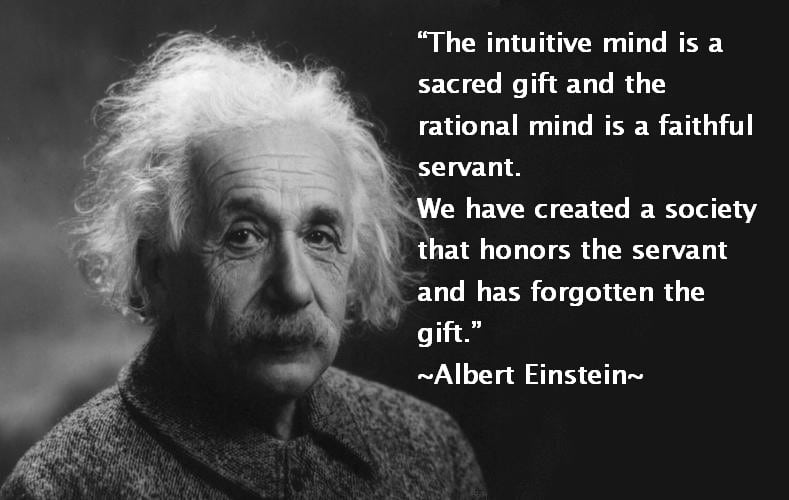
In nursery and primary school our education focusses on our whole bodies – we dance, do drama, and paint with our hands and feet. By secondary school, we're only being educated from the waist up (with occasional classes of PE), and by university we're focussed solely on head-learning. We train the mind to gather and process information – facts, figures, critical thinking, logic, reason – and we test these abilities (and these alone) via incessant exams. The people best at this are ones admired and rewarded most highly in our society: scientists, lawyers, doctors (because western medicine is essentially all reductionist), bankers, computer programmers, etc. On the whole our Western society is skewed towards the rational over the emotional. Einstein knew this when he said
“The intuitive mind is a sacred gift and the rational mind is a faithful servant. We have created a society that honours the servant and has forgotten the gift.”
― Albert Einstein 
The problem is the rational mind is not a good leader. It's too cold and calculating. But it is an excellent advisor. When we let the intuition, the true king/leader, assume its rightful place then logic and reason becomes only one source of information among many. By the same account, emotions and feelings are also just another source of information. In the end I decided to take the bus not cycle!

To take another example, back when I was deciding whether or not to quit my job as an astronomer, my rational mind was screaming "Why quit? You're well-paid, an expert at what you do, and have put in years of training." But it could also calculate how difficult it would be to get a job in the UK and what impact that would have on my relationship. This was all excellent advice. I also knew I wasn't enjoying the day-to-day aspects of my job, feeling quite isolated and frustrated with my colleagues, and I wanted to work more with people in an everyday, grounded sense. All of these things informed my eventual decision, which I feel almost bubbled up out of the muddy quagmire of swirling thoughts and opinions.

I guess you would call that my intuition...


I am part of the Zenways sangha led by Zen master Daizan Skinner, and we meet twice a week at our dojo in Camberwell, London. For more info see www.zenways.org


I'd love to hear from you


Any comments or thoughts about your king and advisors, I'd love to hear from you. Leave a comment below, join the discussion. 

Pass it on

Enjoyed this post? Then please tweet it, share it on Facebook or send it to friends via e-mail using the buttons below.

Thursday, 20 November 2014

The benefits of mindfulness on your health & wellbeing

Many of life’s demands can cause stress, particularly work, relationships and money problems. When we feel fearful or anxious, our body's hard-wired response, evolved over millennia of dangerous encounters in wild, is the "fight or flight" reaction. The problem is that these days, probably the two worst things we could do when faced with, for example, an impending deadline, or an overbearing relative is (1) punch them/someone or (2) run away...

Stress-proofing


Practising meditation and/or yoga, particularly with an emphasis on awareness and mindfulness, has been shown to be an incredibly effective way of stress-proofing ourselves. It does this in two ways: firstly by providing us with a little oasis of quiet in amongst the business of the day (some me-time); and secondly by teaching us how to see things clearly. There's a huge difference between conscious and unconscious stress. The great Zen master Hakuin compared people who were conscious and aware to water whereas ordinary people are like ice. Our mindfulness is like the warm sunlight that can melt away the perceived stress. It's our relationship to the feeling that changes.

Science has been making some great progress in understanding the why exactly lowering our stress levels boosts our health and wellbeing. Let me talk about just a few of the recent discoveries.

Tell me about telomers


Telomers: chromosome caps
Why of course... Telomers are a repeating DNA pattern that act as a kind of protective cap on our chromosomes, shielding their ends from potential damage each time our cells divide and the DNA is copied. In the 1980s an enzyme called telomerase was discovered that can protect and rebuild telomeres. Even so, our telomeres dwindle over time, and when they get too short, our cells start to malfunction and lose their ability to divide – a phenomenon that is now recognised as a key process in ageing. The discovery of telomers won Elizabeth Blackburn the 2009 Nobel Prize in Physiology or Medicine.

As detailed in this lovely article, Blackburn and her group began a study back in 2000 to test the effect of stress on telomer length (at the time genes were seen as being the most important factor, so at the time this idea was highly controversial). The results from their pilot study showed that the more stressed the participants were the shorter their telomeres and the lower their levels of telomerase. Scientists are always marvelled when they manage to connect real lives and experiences to things happening on the molecular level, and in this study they'd done it! Feeling stressed doesn’t just damage our health – it literally ages us!

Researchers have since linked perceived stress to shorter telomeres in Alzheimer’s caregivers, victims of domestic abuse and early life trauma, and people with major depression and post-traumatic stress disorder.

How does it work? The presence of the stress hormone cortisol seems to reduce the activity of telomerase, while oxidative reactions and inflammation (all physiological effects of the stress response) appear to erode telomeres directly. Age-related conditions from osteoarthritis, diabetes and obesity to heart disease, Alzheimer’s and stroke have all been linked to short telomeres.

In one follow-up project, Blackburn and her colleagues sent participants on a three-month meditation retreat, and found that afterwards they had higher levels of telomerase than the control group. A study in 2013 of dementia caregivers found that, after practising 12 minutes of meditation a day for eight weeks, they had significantly higher telomerase activity than a control group. And in another study in 2012 Epel et al. measured the association between telomere length and peoples' natural level of mindfulness. They found those who reported high mind wandering (i.e. lower mindfulness) had shorter telomeres, even after adjusting for stress.

So stress and ageing are clearly very related. No wonder Wallace et al. back in 1982 found that people who'd been practising meditation for five years were physiologically (as shown by their blood pressure, vision, hearing, and skin elasticity) up to 12 years younger than their non-meditating counterparts! For more on that, see this article showing some photographic evidence, or just look at any photo of a prime minister or president – in just a few years they go from looking fresh and vibrant to grey, haggard, and worn out!

New genes, new neurons


In another study, a group based in Massachusetts took blood samples from a group of 19 people who had regular meditation practice, and 19 others who never meditated, and ran genomic analyses (identification of genomic features such as DNA sequence, gene expression, etc) of the blood. They found that the meditating group had suppressed more than twice the number of stress-related genes than the non-meditating group. This is an incredible result, since the more these stress-related genes are expressed, the more the body will have a stress response. This study is in the field of epigenetics, which I've written about before.

Lastly, I just wanted to mention this article detailing some work done here in London that found that increased levels of cortisol seems to decrease neurogenesis (the ability of the brain to produce new brain cells) in adults. Studies have shown that these adult-born neurons appear to have a role in the regulation of stress by possibly augmenting the role of the hippocampus in controlling the stress reaction and/or inhibiting the amygdala (the region of brain responsible for the fear reaction). Neurogenesis has also been linked to brain plasticity.

So, it's never too late to start practising mindfulness and meditation, and slowing down – possibly even reversing – the ageing process!

My next 8-week course in Mindfulness for Health & Wellbeing will start on Friday 16th January, and I'm now taking bookings. See my website for further details.


I'd love to hear from you


If you've noticed that, like me, your mindfulness practice is leaving you looking younger and more radiant, your skin is shiny and there's more of a healthy glow about you, I'd love to hear from you! Leave a comment below, join the discussion. 

Pass it on

Enjoyed this post? Then please tweet it, share it on Facebook or send it to friends via e-mail using the buttons below.